Slab Leak Detection in Temecula, CA
Slab Leak Pros provides slab leak detection Temecula CA homeowners can call when a meter, a bill or a warm floor suggests water is escaping. We find which line is leaking and where, then explain the result before repair is discussed.
Slab Leak Detection for Temecula Homes
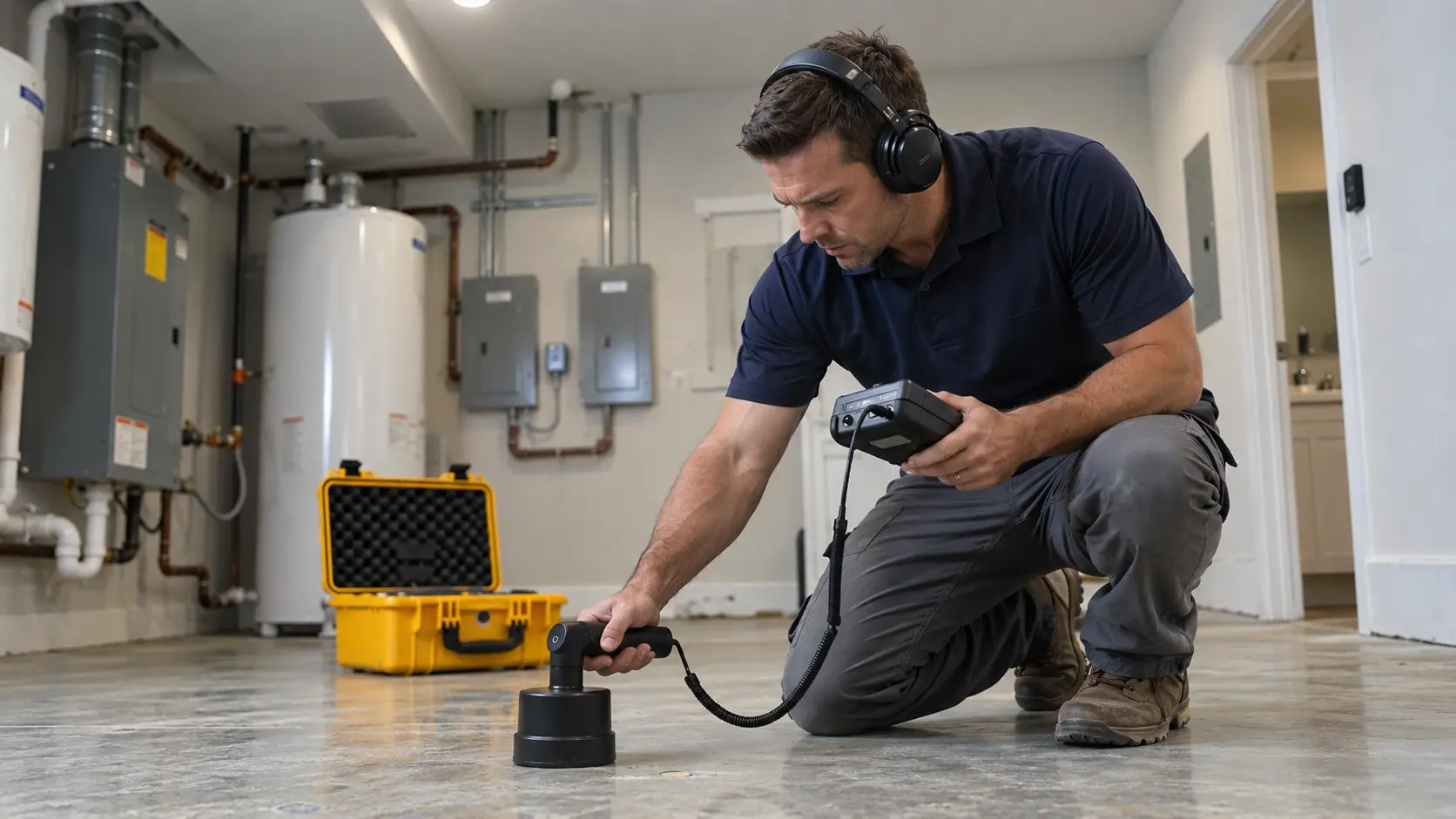
Slab leak detection in Temecula means locating which pressurized water line is leaking in or under the concrete floor, and where, without opening the floor first. A technician tests the meter, isolates lines, listens and uses thermal tools, then reports the line and the spot.
Temecula homeowners usually start with a small clue: a meter that keeps turning, a warm patch on a floor, the sound of water at night, or a bill that rose for no clear reason.
Temecula also splits its utilities in a way that surprises people. The City of Temecula lists one agency for water and a different one for sewer, which changes who you call when something goes wrong underground. The sections below show the agency map, the meter-side rule, and what to document before drying starts.
This page covers detection. For the wider service see Slab Leak Detection Perris, and for what follows a located leak see Slab Leak Repair.
Six Signs That Call for a Leak Test
Every sign is a lead, not a diagnosis. Some of these point away from the slab entirely.
Meter Moving With Everything Off
May point to: flow somewhere past the meter, indoors or outdoors.
Does not prove: a slab leak. A running toilet or a sprinkler valve can turn the dial as well.
Damp Floor Near a Bathroom
May point to: a fixture connection, a wall line, or a line below the floor.
Does not prove: a slab leak. A tired seal or tub overflow is more common.
A Warm Spot Underfoot
May point to: a hot-water line leaking below that spot. See warm spot on the floor.
Does not prove: a leak. Sun through glass can warm flooring too.
Water Heater Area Wet
May point to: a tank, valve or connection problem near the heater.
Does not prove: a slab leak. Most water heater leaks are above the floor.
A Hose Bib That Drips
May point to: a worn outdoor valve, or a stem leaking into the wall behind it.
Does not prove: anything under the floor. It is often a small repair.
A Bill That Climbed
May point to: a steady loss you cannot see. The high water bill guide covers the checks.
Does not prove: where the water goes. Irrigation and guests change bills as well.
In Temecula, Water and Sewer Come From Different Agencies
The City of Temecula lists Rancho California Water for water and Eastern Municipal Water for sewer. A water line leak and a sewer problem can therefore involve two different agencies, and your water bill tells you which one is yours for water.
Rancho Water describes its service area as the city of Temecula, portions of Murrieta and unincorporated parts of southwest Riverside County. The City’s drought page also says rebates come through Rancho Water or Eastern Municipal Water depending on your provider, which means a few Temecula addresses may be served differently. Neither agency’s pages say which streets belong where, so rely on your bill.
| Agency and number | What the official pages say |
|---|---|
| Rancho California Water (951) 296-6900 | Listed by the City of Temecula as the water provider. States that locating and repairing leaks on the property is the customer’s responsibility. Offers leak alerts as a courtesy. |
| Eastern Municipal Water District 800-698-0400 | Listed by the City of Temecula as the sewer provider. For its own water customers, says it does not repair leaks on the customer side of the meter and publishes a concealed leak adjustment form. |
| Your own plumbing past the meter | Slab lines, wall lines, fixtures and the water heater belong to the property owner under both agencies’ wording. |
Numbers and roles come from the City of Temecula’s utilities page. Agency rules change, so confirm current terms before you rely on them.
Five Steps When a Hidden Leak Shows Up on Your Bill
The meter is the dividing line. Anything on the house side is yours to find and fix, which is why the first step is a meter test and not a phone call to a repair company.
Run the meter test
Turn off every faucet and appliance, then check the meter. Rancho Water suggests shutting the main valve, marking the sweep hand and checking again after 20 to 30 minutes. If it moves with the house valve closed, the leak is likely outside the house.
Check your usage history
Rancho Water points customers to MyWaterTracker to review past and current water use, and sends leak alerts by its own program. Look for the date usage stopped following your normal pattern.
Find and fix the cause
Detection names the line and location, and repair follows. Eastern Municipal Water says it may make a partial adjustment for a concealed leak once repairs are made.
Keep proof
Save the repair invoice, a written report of what was found, and photos. A running toilet or a broken sprinkler head is not treated as a concealed leak on the Eastern Municipal Water form.
Ask your agency what applies
Call the agency on your bill and ask whether an adjustment is possible, what it requires and how long it takes. No adjustment amount or deadline should be assumed.
Read the agencies’ own wording at ranchowater.com, its leak alerts page and emwd.org. The water meter leak test guide walks through the check with more detail.
My water bill jumped, but a plumber found no leak. What next?
Rule out the usual suspects first: irrigation settings, a toilet that runs quietly, guests, or a filling pool. If the meter still moves with everything off, ask for a leak detection visit that names the line tested, because a general plumbing visit may not test under the slab.
Water Line or Sewer: Which Problem Do You Have?
A water line leak keeps the meter turning, while a sewer problem shows up as slow drains, gurgling or odor. Mixing them up sends you to the wrong company.
| What you notice | Lead to check first |
|---|---|
| Meter moves with the house valve closed | A pressurized line between the meter and the house, such as a yard line |
| Meter stops with the house valve closed, moves when it is open | A line, fixture or appliance inside the home, possibly under the slab |
| Slow drains, gurgling, sewage smell, meter still | A drain or sewer line problem, which is a different trade |
| Wet ground outside, meter completely still | Irrigation timing, drainage or groundwater rather than a supply leak |
Our sewer line vs water line guide covers the tests that tell them apart. If the issue is a blockage or overflow, Eastern Municipal Water lists 24/7 emergency lines for sewer blockages and service line leaks on its own emergency page.
Are all plumbers able to find a slab leak?
No. Finding a leak under concrete takes detection tools and a method, not only plumbing skill. Before you book, ask what will be tested and how the location will be reported to you.
Hose Bib, Water Heater or Slab: Sort the Small Leaks First
A dripping hose bib or a wet water heater base is usually an above-floor repair, while a slab leak sits on a line you cannot see. Ruling out the visible sources first can save a detection visit, or confirm that one is needed.
- Meter moves with every fixture and the water heater off
- Warm floor spot or a faint hiss at night
- Pressure on one line drops during a hold test
- Dampness at floor level in more than one room
- Drip at a hose bib, valve or supply connector
- Water pooled around the water heater base
- Moisture only below one fixture or one wall
- Meter still when the home is shut off
If both are true, handle the visible leak first and test again. See slab leak vs water leak.
What to Document Before the Dry-Out Starts
Photograph and note everything before drying crews, cleanup or repairs change the scene. The water source, the damage and the timeline are what an insurer or a water agency asks about later.
Some public reviews of local plumbers describe the cause of a bathroom leak being found and the area dried by a mitigation team before the repair, and one reviewer said no insurance claim was needed. Whether a claim makes sense depends on your policy, so ask before you decide.
- The meter, with the leak indicator visible and the time written down.
- The damage, in wide and close photos with something in the frame for scale.
- The timeline, including when you first noticed the sign and when water was shut off.
- The source report, a written note from the detection visit naming the line and location.
- Every invoice, for plumbing, drying, flooring and temporary housing if any.
Coverage for the leaking pipe and coverage for water damage can be treated differently, which the insurance guide explains. Renting? See slab leaks in rental properties.
What a Detection Visit Looks Like
Exact tests depend on your home. For the repair side, see what to expect during a repair visit, and for how the tools work see leak detection methods explained.
Review What You Sent
Photos, video, bills and when the sign first appeared.
Check the Meter
Meter behavior with use stopped, and any agency alert you received.
Isolate the Lines
Hot, cold and sections of plumbing are tested separately.
Pinpoint the Leak
Listening and thermal tools narrow the failure to one area.
Explain the Result
The line, the location, how sure the result is and what was ruled out.
Lay Out the Options
Repair paths are discussed before any cutting is scheduled.
What Written Findings Should Contain
The line involved, the approximate location against a room or fixture, the method used, anything ruled out, and the date. That short record supports a second opinion, an insurance request and a district conversation without anyone relying on memory.
After the Leak Is Found: Your Repair Paths
Repair choice depends on the leak location, the pipe condition and how much access the floor allows. Detection comes first so the options are based on what was found.
Can I keep water on while I wait for the permanent repair?
Sometimes. If the failing line can be isolated or temporarily bypassed, the rest of the home may keep water. Ask what can stay on and what cannot before you agree to a schedule.
What Changes the Repair Decision
No number can be given before the leak is located. Leak location and floor access, pipe material and age, how many leaks are found, and whether a reroute is practical all change the plan.
Ask for the options in writing, and compare them using the questions in what to ask when comparing quotes.
Habits That Catch Trouble Early
Keep your contact details current with your water agency and learn where your main shut-off valve is. Rancho Water calls its leak alerts a courtesy, so they supplement your own checks.
Why Temecula Homeowners Call Slab Leak Pros
Available 24/7
Call on a weekend or after hours and talk through the first steps.
Detection First
The leak is located before repair options are discussed.
Plain Explanations
You hear what was found, how sure the result is and what was ruled out.
Documentation You Can Use
Findings for an insurance, warranty or water agency request.
Temecula Is in Our Area
Temecula is part of the area we serve from Perris.
Also Serving Nearby
This page is for Temecula. If your home is in a neighboring city, these pages cover local details for each.
Slab Leak Detection FAQs
Which agency provides water in Temecula, and who handles sewer?+
The City of Temecula lists Rancho California Water as the water provider and Eastern Municipal Water as the sewer provider. Its drought page also mentions rebates through Rancho Water or Eastern Municipal Water depending on your provider, so check the name on your water bill before you call anyone.
Who is responsible for a leak under my slab?+
The property owner. A slab line sits on the home side of the meter. Rancho Water says it is the customer’s responsibility to locate and repair leaks on the property, and Eastern Municipal Water says it does not repair leaks on the customer side of the meter.
Can my water agency reduce my bill after a hidden leak?+
It depends on the agency, so ask yours. Eastern Municipal Water publishes a Concealed Leak Adjustment Request Form and may make a partial adjustment once repairs are made. A concealed-leak adjustment policy could not be read on Rancho Water’s pages for this guide, so call and ask what applies.
Is a leaking hose bib the same as a slab leak?+
No. A hose bib leak is an outdoor fixture problem that you can usually see dripping or staining the wall below it. A slab leak is on a pressurized line under or in the concrete floor. A moving meter with every fixture off is a reason to test, but it does not tell you which one you have.
Is my problem a water line leak or a sewer problem?+
Water that keeps the meter moving points to a supply line. Slow drains, gurgling or sewage odor point to a drain or sewer problem, which is a different trade. Because Eastern Municipal Water is the listed sewer provider in Temecula, a sewer emergency goes to a different agency than a water line break. Our guide to sewer line vs water line slab leaks explains the difference.
What should I do in the first hour of a weekend leak?+
Shut off the main valve if water is spreading, move belongings off wet floors, take photos, and note the meter reading. Then call for help. A slab leak is rarely a reason to wait until Monday, though it is not always an emergency in the same way as a burst pipe. See is a slab leak an emergency for the details.
Should I dry out the area before the insurance company decides?+
Ask your insurer by phone what it requires before work starts, and do not leave standing water in place while you wait. Take photos and video first, keep drying and plumbing invoices, and save any report that names the source of the water. Your policy sets the exact requirements. The insurance guide explains the usual distinctions.
What should a second opinion include?+
The line that was tested, the method used, where the leak was placed on the floor plan, and how sure the result is. If the first company only said slab leak without naming the location or method, ask for those details in writing before agreeing to cut anything. The quote questions guide lists what to ask.
Do I have to break the floor to find a leak?+
No. Detection locates the problem with meter checks, pressure tests, listening and thermal tools before any cutting. Repair is a separate decision, and options such as rerouting or trenchless methods can reduce how much flooring is opened. See pipe rerouting and trenchless repair.
Slab Leak Pros
1523 Illinois Ave #12, Perris, CA 92571, USA
Phone: (951) 416-3250
Email: [email protected]
Hours: 24/7
Suspect a Slab Leak in Temecula?
Start by confirming whether there is a leak and where it is. Call or send a request and we will talk through the meter check and the next step.