Slab Leak & Water Leak FAQs
Answers to the questions homeowners ask most often about slab leaks, hidden water leaks, detection methods, repair options, costs, and what to expect from service in Perris, CA.
Available 24/7
- Licensed & Insured
- Slab Leak Specialists
- Fast Local Response
- Multiple Repair Methods
- Clear Explanations
Most Common Slab Leak Questions
These questions come up most often when homeowners contact us about a suspected leak. Each links to the full answer below.
Slab Leak Basics
What is a slab leak? ▼
A slab leak is a water line failure in a pipe that runs beneath or through a concrete foundation slab. Most homes built on a concrete slab have water supply lines, and sometimes drain lines, that are embedded in or run under the concrete. When one of those pipes cracks, corrodes, or fails at a joint, the leak occurs in a location that is not directly visible from the living space above.
The water from the leak can move through the soil beneath the slab, come up through the concrete, or accumulate under the flooring, depending on how the water is traveling and where the pipe is positioned.
What causes a slab leak? ▼
Most slab leaks result from one or more of these causes: pipe corrosion over time, friction from pipes rubbing against concrete or soil, soil movement that stresses the pipe, high water pressure, and poor original installation. In Perris and the surrounding Inland Empire, copper pipes laid in the 1980s and 1990s are particularly prone to pinhole leaks as they age, especially in hot water return lines where heat accelerates wear. Hard water mineral buildup also contributes to pipe degradation from the inside.
Are slab leaks common in Perris homes? ▼
Yes, slab leaks are a common plumbing problem in Perris. Much of the residential housing stock was built in the 1980s and 1990s with copper plumbing that is now 30 to 40 years old. The clay-heavy soil in Perris also expands and contracts with moisture changes, which stresses concrete slabs and the pipes beneath them. Combined with the area’s hard water from the Eastern Municipal Water District, conditions that contribute to slab leaks are widespread in local homes.
What is the difference between a hot water slab leak and a cold water slab leak? ▼
Both involve a leaking pipe beneath the slab, but they behave differently. A hot water leak is more likely to cause a warm spot on the floor, since heated water transfers heat through the concrete. Cold water leaks do not usually produce a warm floor but may cause dampness, a higher water bill, or the sound of running water. Hot water lines also fail more frequently because heat accelerates corrosion and mineral buildup inside copper pipe. Identifying which line is leaking affects how detection is approached and which repair option makes the most sense.
Can a slab leak damage my foundation? ▼
A long-running slab leak can affect the soil beneath the foundation, which in some circumstances may lead to soil erosion, settlement, or shifting. Not every slab leak causes foundation damage, and the risk depends on the location, how long it has been running, the volume of water, and the soil type. If a leak has been active for an extended period, it is worth having the surrounding area evaluated. A plumber assesses the pipe and leak; structural concerns require a separate evaluation by a qualified professional. Addressing a confirmed slab leak promptly reduces the likelihood of secondary problems.
Signs & Symptoms
How do I know if I have a slab leak? ▼
Common signs include an unexplained spike in your water bill, the sound of running water when all fixtures are off, warm or hot spots on the floor, damp or wet flooring with no visible spill, low water pressure throughout the home, and cracks forming in floor tiles or baseboards near the slab. A musty odor near the floor can indicate standing moisture beneath the surface. Not every slab leak shows all these signs, and some leaks are slow enough that the only indicator for months is an elevated water bill.
My water bill doubled but I can’t see a leak anywhere. Where could the water be going? ▼
When water usage increases sharply but there is no visible dripping, running fixture, or wet surface, a hidden leak is the most common cause. Water can be leaking beneath the concrete slab, inside a wall, underground along a supply line, or at an irrigation connection. A slab leak in particular is not visible because the pipe is beneath the foundation. To check for a leak at the meter: turn off all fixtures and water-using appliances, then watch the water meter. If the meter dial is still moving, water is going somewhere it should not be. Contact a leak detection service to locate the source before the volume of water loss grows further.
Why is just one part of my floor warm? ▼
A warm or hot spot on the floor is a recognizable sign of a hot water slab leak directly below. When a hot water supply line fails beneath the slab, the escaping water heats the concrete above the leak point. The heat is often localized because the pipe failure is concentrated in one area. This symptom is most noticeable on tile or concrete floors where heat transfers readily. If a warm floor spot appears without a change in radiant heating or another obvious explanation, have it checked.
I can hear water running inside the walls or under the floor, but nothing is on. Should I be worried? ▼
Yes, this is worth investigating. Audible running water with all fixtures off usually means pressurized water is moving through a pipe where it should not be. It can indicate a slab leak, a hidden supply line failure, or a running toilet in some cases. Check the toilets first. If all toilets are confirmed not running and the sound persists, the leak is likely in the plumbing beneath the floor or inside the wall structure. Shut off the main water supply if the sound is persistent and you suspect an active leak, and contact a leak detection service.
My floor tiles started cracking. Could that be from a slab leak? ▼
It is possible. Persistent moisture beneath the slab can soften the subbase material that supports floor tiles, and soil movement from water saturation can cause the slab to shift slightly. Either condition can produce tile cracking, grout separating, or tiles that feel hollow when tapped. Floor cracking is not conclusive proof of a slab leak on its own, since concrete slabs also crack from thermal expansion and soil settling, but when cracking occurs alongside other symptoms like a high water bill or damp flooring, a leak investigation is warranted.
How do I check my water meter for a leak? ▼
Turn off all water fixtures, appliances, and irrigation in the home. Locate your water meter, usually at the street near the curb, and open the cover. Look for a small triangular or dial-type leak indicator on the face of the meter. If it is rotating with all water off, water is actively moving through the system. If your meter has a digital display, note the reading, wait 30 minutes without using any water, and check again. A change in the reading confirms active water loss. This test does not locate the leak, but it confirms one exists and is a useful starting point before calling for service.
Slab Leak Detection
How do plumbers find a leak under a concrete slab? ▼
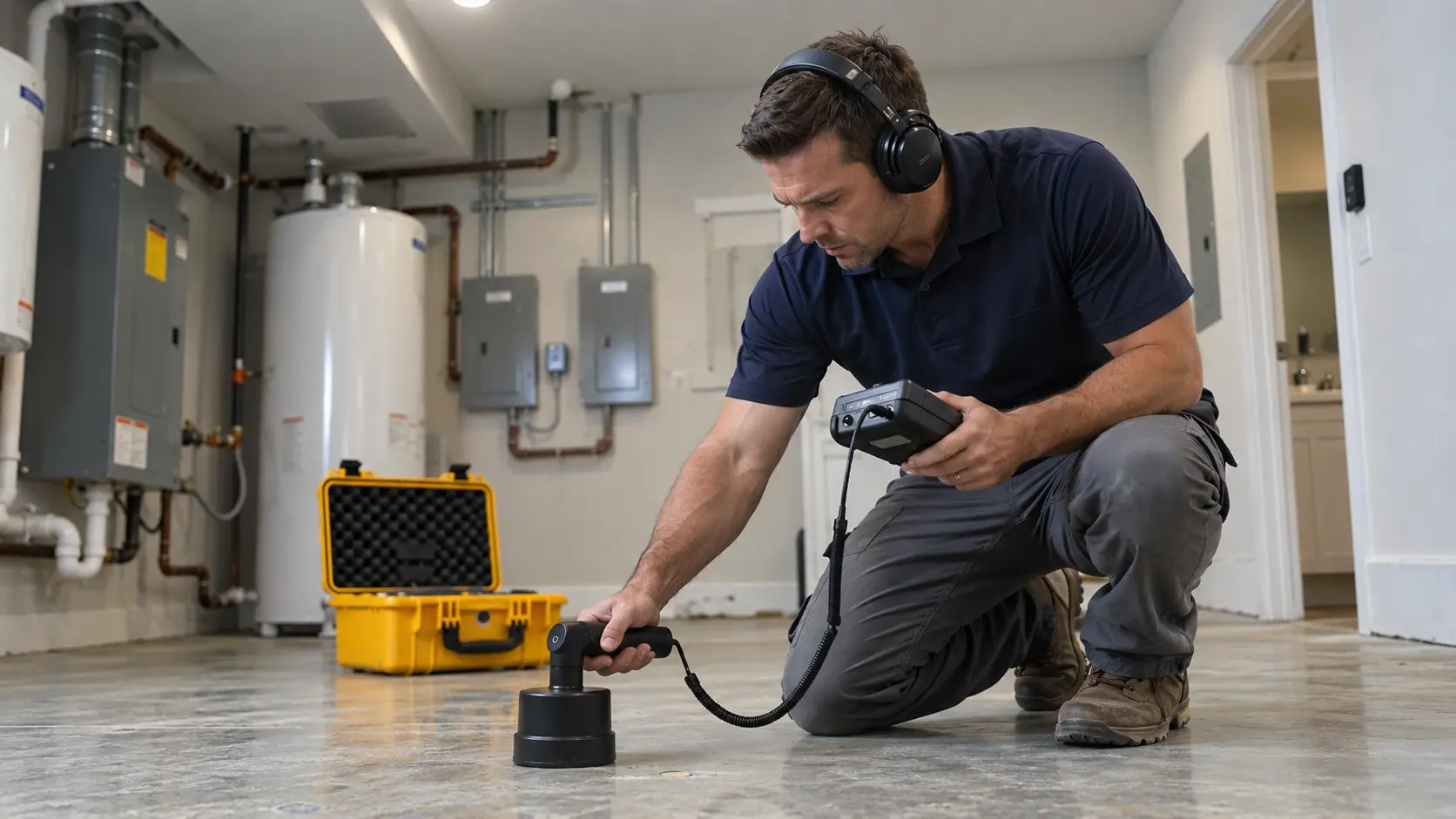
Detection professionals use specialized equipment to locate leaks without opening the slab. Acoustic listening devices amplify the sound of pressurized water escaping a pipe so the technician can identify the leak point. Electronic amplification tools can detect subtle vibrations produced by water movement beneath concrete. Thermal imaging cameras can identify temperature differences at the surface caused by escaping hot water. These tools are used before any concrete is opened, allowing the technician to pinpoint the leak location before repair decisions are made. Learn more about our slab leak detection process.
Do you have to open the floor just to find the leak? ▼
No. Leak detection uses non-invasive equipment that locates the leak from above the surface. Acoustic sensors, electronic amplifiers, and thermal cameras allow the technician to determine where the leak is without cutting concrete. The floor is only opened once the location is confirmed and a repair method is selected. Some older detection methods required more exploratory access, but current equipment significantly reduces unnecessary concrete removal during the detection phase.
How accurate is slab leak detection? ▼
Modern acoustic and electronic detection equipment can locate leak points with reasonable accuracy in most residential situations. The precision depends on the pipe depth, concrete thickness, floor covering material, and the noise environment during the inspection. In most cases, the leak can be narrowed to within a small area before any concrete is opened. If the pipe layout is complex or conditions are difficult, additional pressure testing or gas tracing methods may be used to improve confidence in the location before repair begins.
What happens during a slab leak detection visit? ▼
The technician starts by reviewing the symptoms and confirming water is actively being lost. Pressure testing isolates whether the affected line is the hot supply, cold supply, or drain. Once the line is identified, acoustic and electronic tools are used to locate the sound of escaping water through the slab. The technician marks the leak location, explains the findings, and discusses repair options. Detection typically takes one to several hours depending on the home size, slab conditions, and whether the pipe layout requires additional testing steps.
We can locate it before opening anything. Available 24/7.
Water Leak Detection
What is the difference between slab leak detection and water leak detection? ▼
Slab leak detection focuses specifically on locating pipe failures beneath a concrete slab. Water leak detection is a broader service that covers hidden leaks anywhere in the home, including inside walls, above ceilings, under flooring, and along buried exterior supply or irrigation lines. If you know the suspected leak is under the foundation, slab leak detection applies. If you are losing water but do not know where it is coming from, general water leak detection helps narrow the source before a more specific assessment. We offer both. Learn more about our water leak detection service.
I have a wet spot on my ceiling. Could that be a slab leak? ▼
A wet ceiling almost always indicates a leak from above, not from the slab below. If there is living space or plumbing above the wet spot, the source is likely a pipe, appliance connection, or fixture leak in the floor above. If the wet spot is on a ground-floor ceiling and there is no second story, it may indicate a roof leak or condensation issue rather than a slab problem. Slab leaks typically show up at the floor level or move upward through the slab, not through an overhead surface. A leak detection visit can confirm the source.
Can a slab leak affect a wall or cause moisture inside a wall? ▼
Yes, in some cases. If water escaping beneath the slab migrates along the edge of the foundation and wicks up into a wall cavity, it can produce moisture staining, paint bubbling, or soft drywall near the floor. The initial source is still the under-slab pipe, but the visible damage may appear on a nearby wall rather than the floor surface. This can make diagnosis less obvious. A combination of moisture mapping and acoustic detection typically identifies whether the wall moisture is slab-related or coming from a separate in-wall pipe.
Urgency & What to Do Next
Is a slab leak an emergency? ▼
It depends on the severity. A fast, actively running leak that is producing visible water, causing rapid moisture accumulation, or threatening structural materials is a more urgent situation than a slow pinhole leak that has only produced a gradual rise in water usage. If the leak is causing active flooding or visible damage, shut off the main water supply to the home and contact a plumber immediately. If you have symptoms suggesting a slow leak, such as a higher-than-usual water bill or occasional damp flooring, the situation is still worth addressing promptly even if it is not an emergency. Slow leaks that continue unaddressed can cause cumulative damage over weeks or months.
Should I shut off my water supply if I suspect a slab leak? ▼
Shutting off the main water supply stops water from running through the system, which stops active water loss. If you are seeing rapid water accumulation, active wet areas, or significant visible damage, shutting off the main valve is a reasonable precautionary step while you wait for a technician. For a slow, suspected leak with no visible flooding, you can leave the water on until your service appointment, though turning it off limits any additional water damage in the meantime. Your main shutoff valve is typically at the water meter or at the home’s service entry point.
I think I might have a slab leak. What should I do first? ▼
Start by checking the water meter using the shut-off test: turn off all water in the home, then check if the meter is still moving. If it is, active water loss is confirmed. Note the symptoms you have observed, including any high bill amounts, dates when symptoms began, and locations of damp areas or sounds. If you have not already done so, check that the apparent symptoms are not from a running toilet or a leaking appliance connection first. If those are ruled out, contact a slab leak detection service. The sooner the source is located, the more limited the potential damage.
Can a slow slab leak go undetected for a long time? ▼
Yes. A pinhole leak in a pressurized line beneath the slab can lose water slowly enough that the signs are subtle for months. The water bill may increase gradually rather than spiking suddenly, and moisture may accumulate under the slab without reaching the surface for an extended period. Homeowners sometimes attribute higher water bills to seasonal changes or usage differences without identifying a leak as the cause. Regular monitoring of water usage and attention to floor conditions, especially in homes with older copper pipe, can help catch slow leaks before they cause more significant damage.
Perris Service & Local Conditions
Why do Perris homes have more slab leaks than homes in some other areas? ▼
Several factors contribute. Perris was developed heavily in the 1980s and 1990s, which means a large portion of local homes have copper plumbing that is now 30 to 40 years old and approaching the age when failure rates increase. The soil in Perris contains clay that expands when wet and contracts during dry periods, which creates ongoing movement stress on the concrete slab and the embedded pipes. Water from the Eastern Municipal Water District has relatively high mineral content that promotes scale buildup and internal pitting in copper pipe over time. These conditions create a higher-than-average environment for slab leak development in established Perris neighborhoods.
Does the type of soil in Perris affect slab leaks? ▼
Yes. The Perris Valley sits on alluvial deposits with a significant clay component. Clay soil is expansive, meaning it swells when it absorbs water and shrinks when it dries. This repeated expansion and contraction creates differential movement in the ground beneath a concrete slab. Over years, that movement stresses the slab itself and the pipes that run through it, especially at joints and bends where the pipe is less flexible. Clay soil conditions are a recognized contributing factor to slab leak frequency in the Inland Empire region.
What areas near Perris does Slab Leak Pros serve? ▼
Perris is our primary service area, covering the 92570 and 92571 zip codes. We also serve Menifee, Murrieta, Temecula, Lake Elsinore, Hemet, San Jacinto, Moreno Valley, Riverside, Corona, and Norco. If your property is in a nearby location not listed here, contact us at (951) 416-3250 to confirm availability.
Working With Slab Leak Pros
What services does Slab Leak Pros provide? ▼
We provide slab leak detection, slab leak repair, water leak detection, pipe rerouting, trenchless slab leak repair, and slab leak tunneling. These services cover the full range of under-slab pipe problems and related hidden leak situations for residential and commercial properties in Perris and surrounding areas.
Do you provide both leak detection and repair, or just one? ▼
We provide both. Detection is typically the first step and establishes where the leak is and what pipe is involved. Once the location is confirmed, we explain the repair options that apply to your situation. You can use our detection service to locate the leak and then decide on next steps. Many customers proceed with repair through us as the same service provider, which simplifies coordination and documentation.
What are your business hours? ▼
We are available 24/7. Call (951) 416-3250 or email [email protected] to schedule service or ask a question.
How do I request service from Slab Leak Pros? ▼
Call us directly at (951) 416-3250, available 24/7. You can also submit a service request through our contact page. When you call, it helps to have noted your symptoms, when you first noticed them, and whether you have already checked the water meter. This helps us understand your situation more quickly and schedule the right service visit.
Where is Slab Leak Pros located? ▼
Our business address is 1523 Illinois Ave #12, Perris, CA 92571. We are a mobile service, so we come to your property rather than receiving customers at a walk-in location. Contact us by phone or online to schedule a service visit.
What is the difference between a slab leak and a regular water leak? ▼
A slab leak is a water leak in a pipe buried beneath your concrete slab foundation. A regular water leak can occur anywhere else: inside walls, under sinks, at fixtures, or in exposed pipes. Slab leaks are harder to find and reach because the pipe is encased in concrete, which is why they need specialized acoustic and thermal detection equipment. Both types waste water and can cause damage, but slab leaks carry the added risk of foundation and flooring damage if left unaddressed.
Still Have a Question or Ready to Schedule?
If your question was not answered here, or you are ready to get your leak located and assessed, call Slab Leak Pros. We serve Perris and surrounding communities, 24/7.