Repipe vs Slab Leak Repair:
Which Option Makes Sense?
One slab leak does not automatically mean your entire home needs a repipe. The right answer depends on your pipe age, pipe material, how many leaks have occurred, and what detection reveals. This guide walks through the key factors so you can have an informed conversation with your plumber before committing to either path.
The Short Answer: It Depends on What Was Found
Most homeowners who call after a slab leak ask the same question: should we fix just the leak or repipe the whole house? There is no universal answer, but detection findings, pipe condition, and leak history point clearly in one direction or the other.
- This is the first leak in the home and copper pipe is in good overall condition
- The home is under 20 years old with no prior leak history
- Detection identifies a single isolated section as the problem
- No widespread corrosion or pitting was found during inspection
- Budget for a full repipe is not available right now
- The leak location is accessible for rerouting without major disruption
- A second or third leak has occurred within the same 12-month period
- Detection revealed galvanized or polybutylene pipe throughout the home
- Widespread internal corrosion or pitting was found beyond the leak site
- Multiple sections have already been patched or rerouted over the years
- You are preparing to sell the home and buyers may flag aging pipe
- A whole-house renovation is already underway, making access easier
Neither path is right for every situation. Detection findings give you the clearest picture before you decide.
Targeted Repair vs Full Repipe: A Side-by-Side Look
These two options are not competing products; they are different solutions to different problems. Understanding what each actually involves helps you ask better questions when you talk to a plumber.
| Factor | Targeted Repair | Full Repipe |
|---|---|---|
| Scope of Work | One leak location or section is addressed. Options include spot repair, pipe rerouting above slab, trenchless lining, or tunneling. | All supply lines in the home are replaced with new pipe material, typically copper or PEX. Work affects walls, ceilings, and sometimes the slab. |
| Typical Disruption | Usually limited to the affected area. Rerouting through walls requires drywall work in those sections. Tunneling avoids slab breaking. | Significant. Multiple walls and ceilings are opened to route new pipe throughout the home. Restoration work follows. |
| Pipe Material Affected | Only the failed section is replaced or bypassed. Remaining original pipe stays in place. | All original supply lines are removed and replaced. One uniform material runs throughout. |
| Cost Range | Varies Get a written estimate. Cost depends on access difficulty, leak depth, pipe material, and repair method. | Varies Depends on pipe length, fixture count, wall access, permit, and restoration scope. Always get a written estimate. |
| Best For | Homes with one isolated leak, good overall pipe condition, and copper or newer pipe material throughout. | Homes with recurring leaks, aging galvanized or polybutylene pipe, or widespread corrosion found during detection. |
| Typical Timeline | One to a few days depending on method. Trenchless and rerouting can sometimes be faster than tunneling. | Several days to a week or more depending on home size and restoration scope. |
| Perris Permit Required | Varies by method. Some rerouting and spot repairs require a permit; your plumber should confirm with the City of Perris. | Yes, typically required for a full repipe. Your plumber handles permit coordination. |
| Slab Leak Pros Can Help With | Detection, spot repair, pipe rerouting, trenchless repair, tunneling under slab. | Detection and repair options explained. Slab Leak Pros can discuss findings and what they point to. |
Pipe Material Plays a Major Role in the Decision
The type of pipe in your home is often the single most important factor in whether targeted repair makes sense long-term or whether repiping deserves serious consideration.
Homes in Perris and the surrounding Inland Empire vary significantly in age and pipe material. Homes built in the 1970s through the early 1990s were frequently plumbed with copper supply lines. Copper is a durable material when it has been kept in good condition, but it is not immune to corrosion, pinhole leaks, or the effects of aggressive soil conditions present in parts of Riverside County.
Older homes, particularly those built before the 1960s, may still have galvanized steel supply lines in part or throughout. Galvanized pipe has a known lifespan and corrodes from the inside, gradually reducing water flow and increasing the likelihood of leaks as scale accumulates.
Some homes built or renovated in the late 1970s through the mid-1990s may have polybutylene pipe, a gray plastic material that is now known to be prone to systemic failure over time. Polybutylene is no longer manufactured for residential use for that reason.
CPVC, a cream-colored rigid plastic, was also used in some Inland Empire builds and can become brittle over time, particularly where it is exposed to heat or ultraviolet light. PEX, a flexible plastic tubing, is commonly used today in rerouting work and in new construction. PEX rerouted sections installed as part of prior repairs are generally still in good condition.
If detection confirms that the copper beyond the leak site shows no widespread pitting or corrosion, a targeted repair of the failed section is typically the appropriate response. The remaining copper can continue to perform well.
Heavily scaled galvanized pipe throughout the home is a strong indicator that repiping is worth evaluating. Individual repairs on galvanized may hold temporarily, but the pipe material itself is past its reliable service life when scale is advanced.
Polybutylene is known to fail systemically rather than in isolated spots. A single leak in polybutylene pipe often signals that other sections are at similar risk. Repiping is commonly recommended when polybutylene is found throughout the home.
If a prior repair introduced PEX rerouting in one area of the home, those sections are likely still in good shape. A new leak elsewhere does not mean the previously rerouted PEX sections need to be revisited.
Targeted Repair Methods: What Your Options Look Like
If targeted repair is the right path for your home, there are several methods available depending on where the leak is and what access looks like. Each has different trade-offs in terms of disruption, timeline, and cost.
- Spot Repair with Slab Access
A targeted break in the concrete slab is made directly above the leak. The failed section of pipe is repaired or replaced at that point, then the concrete is patched. This is appropriate when the leak is shallow and accessible, and when breaking the slab is preferable to rerouting through finished walls.
- Pipe Rerouting Above the Slab
The failing underground section is abandoned in place, and a new line is run through the walls, attic, or interior spaces above the slab. The rerouted line bypasses the problem section entirely. This avoids breaking concrete and eliminates that specific section from the underground system. Drywall work is required where the new pipe is run.
- Trenchless Pipe Lining
A flexible epoxy liner is inserted into the existing pipe and cured in place, creating a new pipe within the old one. This method does not require breaking the slab or trenching under the foundation. It works best when the existing pipe is structurally intact enough to support a liner and is accessible at both ends for the lining process.
- Tunneling Under the Slab
Instead of breaking through the slab from above, a horizontal tunnel is dug beneath the foundation to access the pipe. This approach protects the slab and flooring above while allowing direct access to the failed section. Tunneling is often considered when the leak is under a tiled or finished floor that would be costly to restore after a slab break.
- Pipe depth below the slab surface: shallower leaks may favor a direct break, deeper ones may favor tunneling or rerouting
- Location of the leak within the home: under a bathroom tile vs. an unfinished utility area vs. under a living room floor
- Adjacent structures: plumbing that runs near the foundation, post-tension cables, or load-bearing elements affects access options
- Floor and surface material: concrete, tile, hardwood, and carpet each have different restoration costs and sensitivities
- Whether the pipe can be successfully lined: trenchless lining requires pipe that is accessible and in adequate structural condition
- Permit requirements: some methods require permits from the City of Perris; your plumber should confirm before work begins
- Timeline: some homeowners need repairs completed quickly; method affects how fast work can begin and be completed
- Budget: each method has a different cost range; get written estimates for the methods that fit your leak location before choosing
Not every method works for every leak. The location, depth, and surrounding conditions determine which options are actually available for your home. Slab Leak Pros explains what was found and what methods apply before any work begins.
What Affects Cost for Each Path
Neither targeted repair nor full repiping has a fixed price. The variables below are what actually drive the estimate you receive. Understanding them helps you evaluate proposals and ask the right questions.
- Leak location and depth below the slab: deeper or more complex locations require more labor and access work
- Access difficulty: a leak under a finished bathroom with tile costs more to access than one in a utility area with no finish work
- Pipe material in the repair zone: copper replacement costs differ from PEX rerouting or epoxy lining materials
- Repair method selected: tunneling, rerouting, spot break, and trenchless lining each carry different labor and material costs
- Restoration included: patching concrete, drywall, and flooring after the repair affects the total
- Permit fees if required for the method in your area
- Linear feet of pipe to be replaced: larger homes with more plumbing runs cost more than smaller homes
- Number of fixtures served: bathrooms, kitchens, laundry, and hose bibs all add to the scope
- How pipe is accessed: wall and ceiling openings are needed to route new lines; more finished space means more restoration work
- Pipe material chosen for the repipe: copper and PEX are the most common, and each has different material and labor costs
- Permit fees: a full repipe typically requires a permit from the City of Perris
- Restoration scope: patching and painting walls and ceilings after the pipe work is often a significant part of the total
- Whether any slab sections need to be opened to connect the new lines to the existing system
No estimated cost is given here because the actual cost for your home depends on variables we cannot assess without seeing your specific situation. Repair costs and repipe costs vary significantly based on home size, leak location, pipe material, access, and what is found during the job. Always get a written estimate that itemizes what is included before committing to either path. If a quote does not specify what access and restoration work is included, ask before signing.
Situation-by-Situation Guidance
Every home is different, but some situations point clearly in one direction. Use this as a starting framework, not a substitute for detection findings specific to your home.
| Situation | Likely Best Path | Why |
|---|---|---|
| First leak, copper pipe, home 15 years old | Targeted Repair | Isolated failure in a relatively newer home with a material that performs well when in good condition. Repiping is not indicated without additional findings. |
| Second leak within 12 months in same home | Evaluate Repipe | A pattern of recurring leaks suggests the plumbing system is failing broadly, not just at isolated points. A conversation about repiping is warranted. |
| Galvanized pipe throughout, first leak | Evaluate Repipe | Galvanized pipe with internal scale is prone to additional failures once it begins leaking. Repair can be done, but a repipe discussion is worth having alongside it. |
| CPVC that is cracking or flaking | Evaluate Repipe | CPVC that has become brittle tends to fail in multiple spots rather than just one. Targeted repair may not hold if the pipe material throughout has degraded. |
| Home is 10 years old, copper, isolated leak | Targeted Repair | At 10 years, a copper system should have substantial remaining life. Fix the isolated failure and monitor. |
| Home is 40 years old, original galvanized | Evaluate Repipe | Galvanized pipe at 40-plus years is past its expected reliable service life. A repipe evaluation makes sense whether or not a leak has occurred. |
| Preparing to list the home for sale | Evaluate Repipe | Aging or failing pipe material is a common inspection flag that gives buyers negotiating leverage. Discuss with your real estate agent whether the investment pencils out. |
| Post-earthquake, leak discovered | Targeted Repair First | Address the immediate leak first to restore water service. Have a plumber assess whether earthquake movement affected other sections before deciding on further work. |
| Budget is very limited right now | Targeted Repair | A targeted repair addresses the immediate problem. Document what was found and plan for repiping on your timeline if the pipe material warrants it. Do not delay a repair needed to restore water service. |
What Professional Detection Tells You Before You Decide
Starting with professional leak detection gives you the information needed to evaluate your repair options accurately. Without it, you are making a major decision based on incomplete information.
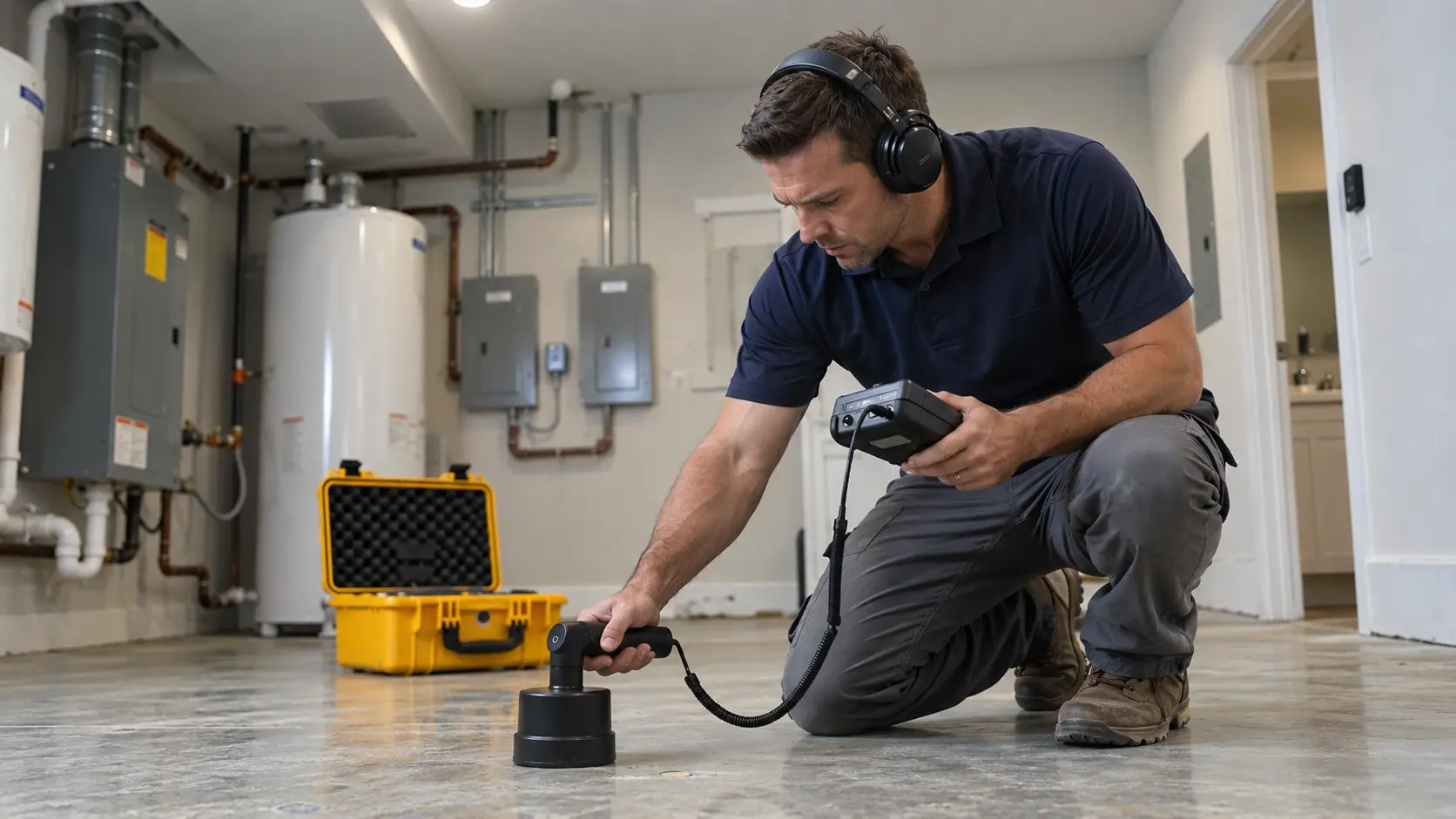
Professional slab leak detection uses electronic listening equipment and thermal imaging to locate the precise point of failure below the slab without breaking concrete. This process identifies where the water is escaping, the approximate depth of the pipe, the material of the affected line, and the conditions immediately surrounding the leak.
That information directly shapes the repair conversation. A plumber who knows exactly where the leak is and what the surrounding pipe looks like can explain your options specifically rather than in general terms. They can tell you whether the pipe adjacent to the leak shows signs of corrosion, whether the location is accessible for rerouting, and whether a trenchless approach is feasible at that specific spot.
Detection findings also give you a record. If a second plumber reviews the same findings and recommends a different approach, you have the documentation to compare. If a leak occurs again in a different location a year later, the prior report establishes a baseline. For homeowners considering whether to repipe, a detection report that shows isolated failure versus widespread corrosion is the clearest possible input for that decision.
Slab Leak Pros provides written documentation of what was found during detection. This report is yours to keep and share with other plumbers, your insurance company, or a home inspector as needed.
Electronic detection narrows the failure to a specific location rather than a general zone. This limits the access work needed and reduces guesswork before repair begins.
Detection equipment locates the leak without breaking concrete or opening walls. You get the information before any access work begins.
Slab Leak Pros provides a written record of detection findings. This document is yours to keep, share with your insurance carrier, or use when comparing repair proposals.
After detection, Slab Leak Pros explains what was found and what repair options apply to your specific leak location. You get a clear picture before any work begins.
Slab Leak Pros works in Perris and surrounding Riverside County communities. Local knowledge of soil conditions, common pipe materials in area homes, and permit requirements in the City of Perris is part of what we bring to every job.
Serving Perris and Surrounding Riverside County
Slab Leak Pros serves homeowners throughout Perris and the broader Riverside County area for slab leak detection and repair. If you are outside Perris city limits, call to confirm whether your location is within our service area.
Slab leak patterns in this region reflect the soil conditions, home ages, and pipe materials common to Inland Empire communities. Homes built during the same eras and with the same materials tend to present similar issues. Our experience with local conditions informs how we approach detection and what repair options we recommend for specific neighborhoods and home types across the area.
Frequently Asked Questions
Common questions from Perris homeowners weighing slab leak repair against a full repipe.
Is repiping covered by homeowner’s insurance?
Can detection tell me if I need a repipe?
Related Services and Resources
Whether your situation calls for detection first, a specific repair method, or more information about cost and coverage, these pages have what you need.
Get Your Repair Options Explained Before You Decide
Knowing whether to repair or repipe starts with knowing what was actually found. Slab Leak Pros diagnoses the leak, documents the findings, and explains your options in writing before any work begins. Call any time to schedule detection or to ask questions.
Available 24/7 | Perris, CA | [email protected]