
Slab Leak in a Rental Property in Perris, CA
What tenants, landlords, and property managers should document, who arranges leak detection, and how repair and responsibility questions are sorted out. Locate the leak first, then decide who handles what.
A warm patch on the tile, a damp spot near a baseboard, the sound of running water at night, or a water bill that jumps without any change in use can all point to a hidden leak. When that happens in a rental, two separate questions show up at once. Where is the water going, and what caused it? And who is responsible for arranging and paying for each part of the response?
Those questions should be handled in order. Detection comes first, because symptoms alone do not show whether the source is a slab leak, an appliance connection, a drain line, or water entering from outside. They also do not show who caused the problem. A slab leak in a rental property in Perris is easier to resolve when both sides work from the same facts.
This guide gives tenants, landlords, and property managers one shared sequence. It is general plumbing and process information, not legal advice or an insurance opinion.
Slab Leak in a Rental Property: The Direct Answer
A suspected slab leak in a rental should be documented and reported to the landlord or property manager in writing as soon as possible. The landlord or manager generally coordinates inspection and repair of the building's plumbing, and the leak should be professionally located before either side assumes fault.
Who ends up paying can depend on what caused the damage, the lease, insurance coverage, and California law. No one should decide fault from symptoms alone.
What a Tenant Should Do First
Most of the value a tenant can add happens in the first day: clear observations, good records, and a prompt written report. None of it requires opening a floor or touching plumbing.
Write down what you notice
Note the date you first saw it and what it is: a warm floor area, dampness, a running-water sound, a pressure change, or an unusual water bill.
Take photos and short videos
Capture visible moisture, stains, lifting flooring, or damp baseboards. Photos taken early show how the problem developed.
Shut off water only if it is safe and active
If water is actively leaking and the main shutoff is safely reachable, closing it can reduce continuing water loss. Do not cut into walls or remove flooring.
Notify the landlord or property manager in writing
Use text, email, or the property portal so there is a record. Say what you see, when it started, and whether water appears to be spreading.
Say clearly if water is actively flowing
Active water, water near electrical equipment, or damage that is growing deserves urgent wording in your message.
Keep reasonable access available
Respond to scheduling requests for an inspection or detection visit so the source can be found quickly.
Keep records going
Save every reply, visit date, and contractor note, and photograph damaged belongings before moving or discarding them.
Tenant Documentation Checklist
A short, dated record protects everyone. Keep these in one place, such as a notes app or a single email thread.
- Date the problem was first noticed
- Photos or video of visible moisture, stains, or flooring changes
- Location of any warm floor area
- Notes on running-water sounds and when they occur
- Water bill changes, if the tenant receives the bill
- Meter observations, only if the meter is safely accessible
- Every message sent to the landlord or property manager
- Every response and the date it arrived
- Dates of any contractor or detection visits
- Photos and a list of damaged personal belongings
What a Landlord or Property Manager Should Do
A tenant report is the start of an investigation, not a finding of fault. A calm, documented response keeps a plumbing problem from turning into a dispute.
- Acknowledge the report promptly and in writing
- Gather details: location, timing, symptoms, and whether water is active
- Decide urgency, treating active water as time-sensitive
- Arrange appropriate inspection or professional water leak detection
- Coordinate lawful access with proper notice (see the access section below)
- Get the contractor's findings in writing, including which component failed
- Determine repair scope before ordering restoration
- Tell the tenant the next steps and expected timing
Landlord and Property Manager Documentation Checklist
- The tenant's report and the date it was received
- Photos, dates, and symptom descriptions
- Service and repair history for the property's plumbing
- Water bill data, where it is relevant
- Detection findings and the method used
- Repair recommendations and options considered
- Entry notices sent to the tenant
- Insurer claim number, if a claim is opened
- Repair and restoration records
- A communication log with the tenant
Do Not Assign Blame Before the Leak Is Located
This is the most useful rule in a rental. A wet floor does not prove tenant negligence, landlord neglect, pipe failure, a slab leak, a hot-water leak, or a sewer leak. Each of those is a conclusion, and detection is what supports or rules out each one.
| Possible Source | How It Can Show Up | Why It Matters |
|---|---|---|
| Pressurized supply line under the slab | Warm floor area, running-water sound, higher bill | May lead to a slab leak repair evaluation |
| Appliance or fixture connection | Moisture near a water heater, dishwasher, or toilet | Usually a surface repair, not a slab repair |
| Drain or sewer line | Odor, slow drains, damp area | Different repair path and a sanitation concern |
| Irrigation or outdoor water entering the home | Dampness along exterior walls | Source is outside the plumbing under the floor |
| Roof or window intrusion | Staining after rain | Building envelope issue, not plumbing |
| HVAC condensate | Moisture near equipment | Equipment drainage issue |
Related guides on warm spots on the floor and unexplained high water bills show how each symptom can have more than one explanation.
Detection First: The Order That Prevents Wasted Repairs
| Situation | Reasonable Starting Point | Next Step |
|---|---|---|
| Source of the water is unknown | Water leak detection | Narrow the source before any repair |
| Under-slab supply leak is suspected | Slab leak detection in Perris | Locate the leak area using non-destructive methods first |
| Slab leak is confirmed | Slab leak repair options | Evaluate the repair approach for that location |
| Repeated or widespread failures are found | Pipe rerouting or a full repipe | Consider only when the findings support it |
Rerouting or repiping is not automatic. One slab leak does not mean the whole home needs new plumbing.
Is the Source of the Water Still Unknown?
If the cause has not been confirmed, professional leak detection gives the landlord, tenant, and any insurer something concrete to work from. Slab Leak Pros can help find where the water is going.
Who Usually Arranges the Plumber?
The landlord or property manager will usually coordinate repairs involving the rental's plumbing system, since it is part of the building. How that plays out can still depend on the lease, the cause of the problem, and whether the situation is an emergency.
California law frames this at a high level. Civil Code section 1941 describes the landlord's duty to keep a rental fit for occupation and to repair later dilapidations that make it untenantable, and Civil Code section 1941.1 lists plumbing in good working order and a water supply that produces hot and cold running water among the conditions a tenantable dwelling must substantially have. Whether a particular leak triggers those rules depends on the facts.
Can a tenant call a plumber?
A tenant can usually call for information or help with an emergency. What should normally go through the landlord or property manager first is anything larger: opening walls or the slab, authorizing a repair, or ordering a full repair. A tenant who hires a contractor and sends the bill to the landlord may not be reimbursed.
- Calling for information or a quote
- Emergency steps to limit water loss
- Authorizing destructive work
- Opening the slab or walls
- Ordering a full repair
California does include a repair-and-deduct remedy in Civil Code section 1942, but it is narrow. It involves conditions that make the premises untenantable, notice to the landlord, a reasonable time to respond, a cost cap tied to one month's rent, and a limit on how often it can be used. It is not available if the condition was caused by the tenant's own violation of certain duties. Tenants should not treat it, or withholding rent, as a shortcut, and anyone considering it should get legal advice first.
Tenant-Caused Damage vs Normal Plumbing Failure
The cause matters, and the evidence should decide it. California law also lists tenant duties, including properly using plumbing fixtures. Where a tenant's substantial violation contributes substantially to a problem, the landlord's repair duty can be affected. That is a narrow situation that requires actual evidence.
Property or plumbing factors
- Pipe corrosion or pitting
- Fitting or joint failure
- Age and deterioration
- Pressure-related stress
- Ground movement
- Installation issues
Tenant-related factors
- Only where there is real evidence of misuse or damage
- Not assumed from the symptom
- Not assumed from who lives there
Do not assume tenant fault, and do not assume landlord fault. The leak location, the failed component, and its condition are what detection findings provide.
Building Damage vs Tenant Personal Property
A slab leak can damage two different categories of property, and responsibility and insurance can differ between them.
| Category | Examples | Who Typically Documents It |
|---|---|---|
| Building and structure | Slab, drywall, landlord-owned flooring, cabinets, plumbing, structural materials | Landlord or property manager |
| Tenant personal property | Furniture, electronics, clothing, personal items | Tenant |
Photograph and list belongings before moving, cleaning, or discarding them. Landlords should document building damage and any restoration separately.
Landlord Insurance vs Renters Insurance
Landlord or property insurance
- May relate to building damage
- May relate to restoration after a covered water loss
Renters insurance
- May relate to tenant personal property
- May include certain loss-of-use costs, depending on the policy
Whether anything is covered depends on policy wording, the cause of the loss, exclusions, limits, the deductible, timing, maintenance history, and the insurer's decision. Nothing here promises coverage. For a closer look at how claims are evaluated, see whether insurance covers slab leaks in California.
Access for Leak Detection or Repair
Detection and repair usually need someone inside the home. California's entry rule, Civil Code section 1954, lists necessary or agreed repairs and emergencies among the purposes for which a landlord may enter. It generally calls for reasonable written notice stating the date, approximate time, and purpose, with 24 hours presumed reasonable, and entry during normal business hours unless it is an emergency or the tenant consents. It also says the right of entry cannot be used to harass the tenant.
The practical takeaway is simple. Tenants should cooperate with lawful access so the leak can be found quickly, and landlords should follow the applicable notice rules. Emergencies can be treated differently, and the statute has details and exceptions, so either side with a specific question should check the current text or get legal advice.
Temporary Relocation and Habitability
A slab leak does not automatically mean the tenant must leave, or that rent is reduced, or that a hotel is covered. Those questions depend on the extent of the damage, whether the home is still habitable, the lease, any insurance coverage, how long repairs take, and applicable California law.
If part of the home becomes unusable, both sides are better served by writing down what is affected, asking how long repairs are expected to take, and getting advice on the specific situation. The California Department of Real Estate landlord and tenant guide is a good starting reference for habitability and repair basics.
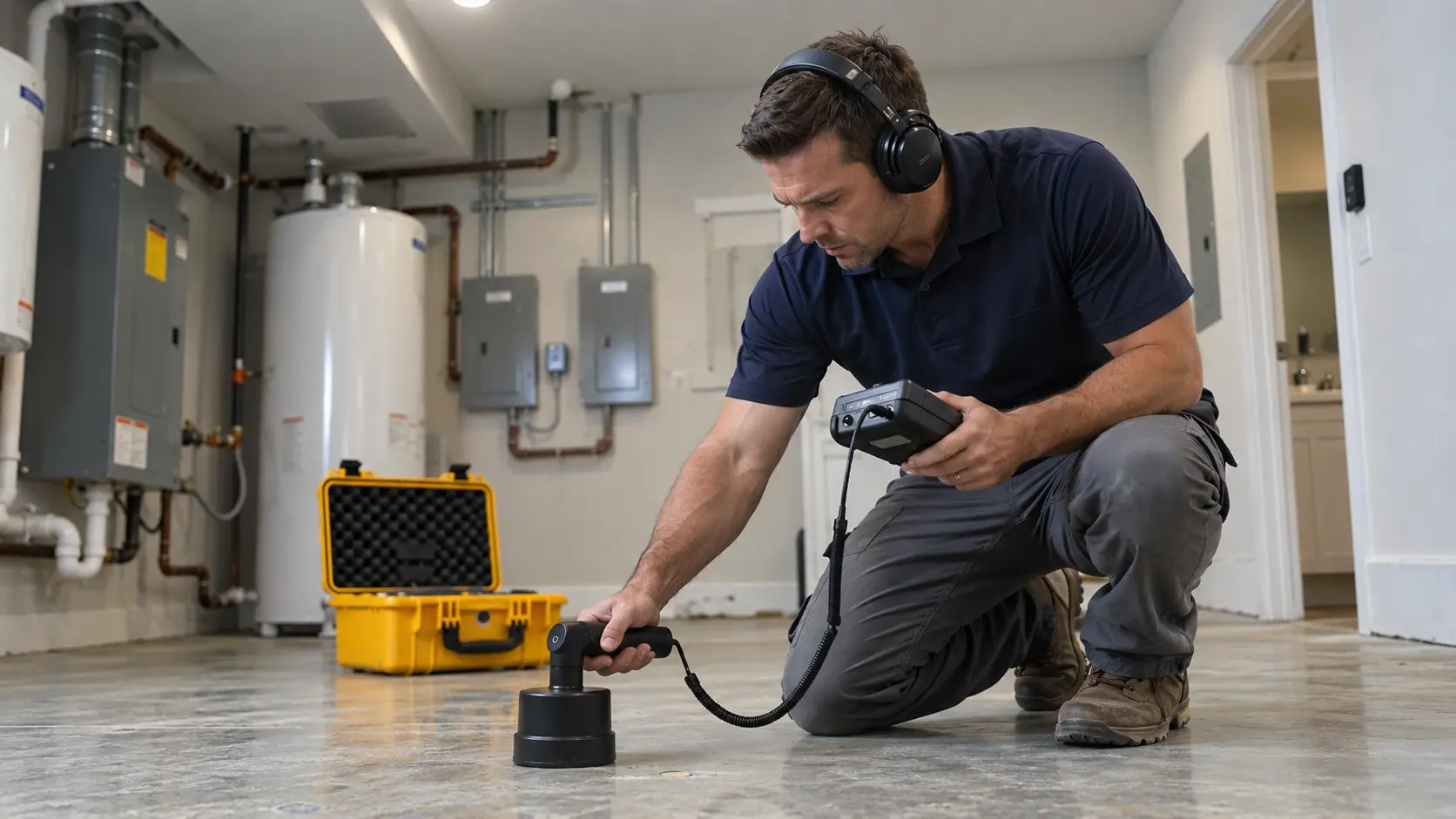
How Slab Leak Detection Works in a Rental
Detection is a narrowing process, not a single test.
- Symptoms and history are reviewed, including bill changes and where the signs appear
- Meter and plumbing observations are used where appropriate
- The hot and cold systems are considered separately
- Acoustic, pressure, moisture, and thermal methods are used where they help
- The likely leak area is narrowed down
- Repair options are then evaluated
Every method has limits. Thermal imaging does not see through concrete like an X-ray. Pressure testing can confirm that water is being lost without always showing exactly where. Acoustic detection depends on site conditions. Opening the floor is not automatically the first step.
What Happens After the Leak Is Confirmed
- A localized repair at the leak
- Replacing a short section of pipe
- Rerouting the line around the affected area
- A less invasive approach such as trenchless repair, where it is technically suitable
- Tunneling as an access method
- A broader repipe, only when repeated or widespread failures justify it
| Option | When It May Be Considered | Main Trade-Off | Scope |
|---|---|---|---|
| Direct repair | A single leak with sound surrounding pipe | May not address other weak points | Limited to the leak area |
| Rerouting | Access to the original path is difficult | Changes the pipe path | Replaces the affected run |
| Full repipe | Repeated leaks or widespread deterioration | Larger project | Much of the supply system |
The repipe vs slab leak repair guide explains how to weigh these options.
Common Tenant Mistakes
- Waiting too long to report the problem
- Reporting only verbally
- Authorizing destructive work without coordinating with the landlord
- Assuming a warm floor proves a slab leak
- Throwing away damaged items before documenting them
- Assuming insurance or legal responsibility before the source is known
- Attempting unsafe DIY plumbing repairs
Common Landlord and Property Manager Mistakes
- Dismissing early signs without an inspection
- Assuming tenant fault before finding the source
- Repairing visible damage without locating the leak
- Not documenting contractor findings
- Poor or delayed communication
- Treating insurance coverage and responsibility as the same thing
- Repairing symptoms repeatedly without evaluating repeated failures
Tenant and Landlord Quick-Action Table
| Situation | Tenant | Landlord or Property Manager |
|---|---|---|
| Possible leak | Document and report in writing | Review and arrange an inspection |
| Active water | Report urgently, and shut off safely if appropriate | Arrange an urgent response |
| Leak location unknown | Share observations | Arrange leak detection |
| Slab leak confirmed | Cooperate with access | Review repair options |
| Personal property damaged | Document belongings | Document building damage |
| Insurance question | Review the renters policy | Review the property policy |
| Repair completed | Confirm access and conditions | Document repair and restoration |
For active water, the guide to whether a slab leak is an emergency explains how to judge urgency.
Perris Context
Nearly 80 percent of single-family homes in Perris are built slab-on-grade, so a good share of supply plumbing can sit in or beneath concrete. The area also has expansive clay soil that swells in wet seasons and shrinks in dry ones, and that movement can stress pipe where it meets concrete. It does not affect every home equally.
Many Perris homes receive water service from Eastern Municipal Water District, and a changed water bill can be an early clue. Water chemistry is more complicated than one number, so we do not treat hard water as proof of a slab leak. The only reliable answer for a specific rental is what detection shows.
Slab Leak in a Rental Property: Common Questions
Who is responsible for a slab leak in a rental?+
Should a tenant shut off the water?+
Can a tenant call a plumber?+
Does a landlord have to fix a slab leak?+
Can a tenant deduct plumbing repairs from rent?+
How quickly should a slab leak be investigated?+
Does renters insurance cover water-damaged belongings?+
Does landlord insurance cover the plumbing repair?+
Can a landlord enter the rental to repair a leak?+
What if the slab leak makes part of the property unusable?+
What if the tenant caused the damage?+
Should a landlord repipe after one slab leak?+
The Takeaway
Document the problem, report it in writing, locate the leak before assigning blame, and keep plumbing repair, insurance coverage, and legal responsibility as three separate questions. That order protects both sides.
Need to Find Where the Water Is Going?
Whether you are a tenant, landlord, or property manager, the next practical step for a suspected hidden leak is locating it. Slab Leak Pros can help find the source and explain the repair options.