Pre-Purchase Plumbing Inspection for Home Buyers in Perris
What a plumbing focused evaluation may include, what each test can and cannot show, and how to decide whether more testing is worth it before you buy. Clearer information, without the guesswork.
A home can look clean, freshly painted, and well kept while its plumbing tells a different story. Most of the system sits behind walls, under floors, and inside or beneath the concrete slab, which is why plumbing questions often come up late in a purchase, after the walkthrough and sometimes after the general inspection.
A pre-purchase plumbing inspection is a way to get more detail about the plumbing system before you commit. It does not promise a problem-free house. It gives you more information about the accessible plumbing, flags conditions that deserve a closer look, and helps you decide whether any further testing is worth arranging.
This guide is written for the buyer. It explains what a plumbing-focused evaluation may include, what each test can and cannot show, which findings are normal and which deserve questions, and when you probably do not need anything more. It is general information, not legal or real estate advice.
Should You Get a Plumbing Inspection Before Buying a Home?
A plumbing-focused inspection can be worth it when you want more detail than a general visual inspection provides, especially if the home is older, the plumbing history is unclear, repairs are visible, there are signs of moisture, pressure seems unusual, old piping is present, or a past slab leak is known.
Not every property needs every available test. If the history is clear, the general inspection is clean, and nothing looks off, you may not need much more. The point is to answer the specific plumbing questions you still have.
Home Inspection vs Plumbing Inspection
A general home inspection and a plumbing-focused evaluation have different jobs. Home inspectors review many systems in one visit, from roof to electrical to foundation, and they are a valuable part of buying a home. A plumbing professional can go deeper on plumbing-specific questions that come out of that report or the walkthrough.
| General Home Inspection | Plumbing-Focused Inspection |
|---|---|
| Reviews many home systems in one visit | Focuses specifically on the plumbing system |
| Broad, mostly visual inspection | More detailed plumbing evaluation where the concern justifies it |
| Notes visible defects and conditions | Can investigate a specific plumbing concern |
| May recommend a specialist for further review | A plumber can evaluate plumbing-specific issues in more depth |
Neither replaces the other. Many buyers use the general report to decide whether plumbing needs a second look.
What a Pre-Purchase Plumbing Inspection May Include
Scope depends on the property, access, symptoms, age, plumbing layout, and what the buyer asks for. Not every inspection includes every item below.
- Visible water supply piping
- Visible drain piping
- Fixtures and their supply connections
- Shutoff valves
- Water heater connections
- Visible corrosion
- Water pressure
- Observable leaks and moisture
- Signs of prior repairs, rerouting, or repiping
- Water meter behavior
- Indicators of a possible slab leak
- Drainage concerns
A good evaluation tells you what was checked, what each finding might mean, and what could not be checked.
Water Pressure
Pressure matters because it affects fixtures, connections, and long-term stress on piping. Unusually low pressure, unusually high pressure, and pressure that swings from one fixture to another can each have several explanations.
A reading is one piece of information, not a diagnosis. Low pressure might point to a restriction, a valve issue, or a leak, and high pressure might relate to a regulator or supply conditions. Pressure belongs in a broader assessment alongside the pipe materials, the fixtures, and the repair history.
Pipe Materials and Condition
Buyers may run into copper, PEX, CPVC, galvanized steel in older properties, and other visible materials. Material alone does not decide condition. A better way to read the plumbing is material plus age plus installation plus current condition plus repair history.
| Material | What to Understand | Condition Clues |
|---|---|---|
| Copper | Common in many homes and can serve for a long time | Corrosion, pinhole repairs, staining, repair history |
| PEX | Flexible plastic piping, often seen in newer work or repairs | Fittings, routing, how it connects to older pipe |
| CPVC | Rigid plastic piping used in some systems | Fittings, cracking, installation quality |
| Galvanized steel | Seen in some older properties | Internal buildup, reduced flow, corrosion |
We do not assume which material a given Perris neighborhood has. The only dependable answer is what is visible in the home and what its records show.
Copper Pipe Condition
Because slab leaks involve supply lines, copper deserves its own section. Old copper does not automatically need replacement, and young copper is not automatically trouble free. Condition and history matter more than the calendar.
- Visible corrosion or green or white deposits at joints and fittings
- Pinhole repairs or clamps on accessible pipe
- Accessible copper versus copper that runs under the slab
- Whether repairs are isolated or repeated
- How the age of the pipe compares with its actual condition
For a deeper look at how age fits in, see how copper pipe age relates to slab leak risk.
Signs of Previous Plumbing Repairs
Evidence of past work is not automatically a problem. A repair can show that something was found and fixed properly. The buyer's goal is to understand what happened and what was done.
- Patched drywall or ceiling repairs
- Floor repairs or replaced flooring in one area
- Concrete patches
- Newer pipe sections in an older system
- PEX next to older copper
- Abandoned pipe
- Rerouted lines
- A newer manifold
- Replaced shutoff valves
When you see one of these, ask when it was done, why, by whom, and whether records exist.
Previous Slab Leak History
If seller disclosures or visible repairs point to a previous slab leak, your questions get more specific. Find out when it happened, where it was, how many prior leaks there were, how it was repaired, whether the line was rerouted or the home was repiped more broadly, whether damage was restored, and whether records exist.
That topic has its own guide. See buying a home with a past slab leak for what to ask the seller, which documents to request, and how repair methods differ. This page stays focused on the plumbing system as a whole.
Hidden Water Leak Concerns
Some signs can suggest water is going where it should not, but none of them proves a hidden leak by itself.
- Unexplained moisture or staining
- Warm flooring
- Running-water sounds when nothing is on
- Water meter movement
- Water pressure changes
- Unexplained water usage
If evidence warrants it, professional water leak detection is a separate service from a general plumbing evaluation, and slab leak detection in Perris applies where an under-slab supply leak is suspected.
Water meter checks
Meter movement with everything off may indicate ongoing water use. It does not tell you where the water is going, whether the leak is under the slab, or which line is involved. Treat it as a clue that supports further testing, not a result.
Warm spots and water bills
A warm area on the floor can be one clue associated with a hot-water line under the slab, but other explanations exist, so do not diagnose from temperature alone. See what a warm spot on the floor may mean. Recent water use can add context, since unusually high usage may justify a closer look, but usage varies for many reasons. See the high water bill guide.
Leak Detection Methods and Their Limits
| Method | What It Can Do | What It Cannot Do |
|---|---|---|
| Thermal imaging | Shows surface temperature patterns that may help narrow an area | Does not see through walls, floors, or concrete, and is not proof by itself |
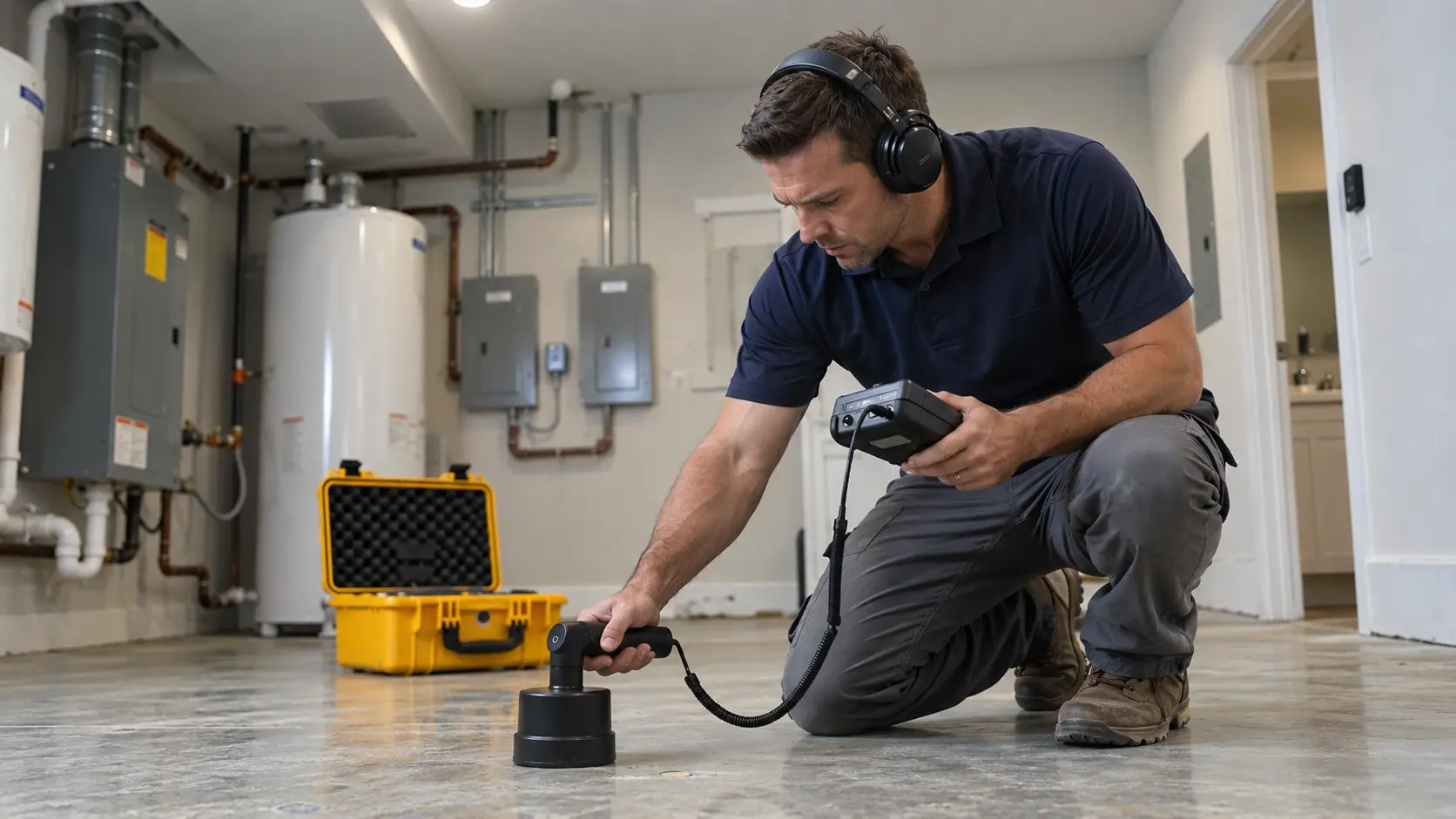
| Acoustic detection | May help locate certain pressurized leaks from sound or vibration | Not every leak is audible, and it does not always find the exact point |
| Pressure testing | Gives evidence about whether part of a system holds pressure | Does not always identify the exact leak location |
| Meter observation | Suggests whether water is being used or lost | Does not locate the leak or say which line is involved |
No single tool works on every plumbing system. A competent evaluation combines several, explains what each one showed, and says plainly what could not be confirmed.
Have a Plumbing Concern Before Buying a Perris Home?
Slab Leak Pros can help evaluate signs of hidden water or under-slab leakage when additional plumbing investigation is warranted.
Drain and Sewer Considerations
Buying a home can raise drainage questions even when the supply plumbing looks fine. Recurring backups, slow drains, odors, earlier sewer repairs, root intrusion where it applies, and older drain materials are all worth asking about.
Should you get a sewer camera inspection?
It depends. It may be useful given the home's age, drainage history, visible issues, known sewer problems, or findings from the general inspection. It is not something every buyer always needs. If the situation calls for one, it is a separate assessment and often a separate specialist.
Water Heater, Fixtures, and Shutoffs
- Water heater: visible leaks, corrosion, condition of connections, the shutoff, installation condition, and any age information on the label
- Main shutoff: know where it is and whether it appears accessible, and note whether fixture shutoffs are present
- Faucets, toilets, and showers: signs of leakage, running toilets, and condition of visible supply connections
Do not force a corroded or stuck valve. If a valve will not turn easily, note it and let a professional handle it. Small fixture leaks can raise water use without pointing to a slab leak, so they are worth sorting out separately.
Questions to Ask the Seller
Ask through your agent and get answers in writing. California sellers generally provide a Transfer Disclosure Statement that asks about known significant defects or malfunctions in systems such as plumbing, according to the California Department of Real Estate disclosure booklet. That statement is not a warranty and does not replace your own inspections, and seller answers to other questions depend on the sale, so your agent can explain what applies.
- Have there been previous plumbing leaks?
- Has there ever been a slab leak?
- Has any plumbing been rerouted?
- Has the house been partly or fully repiped?
- Are repair invoices available?
- Has water damage occurred?
- Were walls or floors opened for plumbing work?
- Are permits or records available where applicable?
- Has the sewer line been repaired?
- Have there been recurring drain problems?
- Are recent water bills available?
Documents to Request
Not every owner will have every document, so treat this as a list of useful things to ask for, not a requirement.
- Plumbing invoices
- Repipe documentation
- Leak detection reports
- Restoration invoices
- Seller disclosures
- Permits, where applicable
- Earlier inspection reports
- Water damage records
- Insurance related records, if available and appropriate. For how coverage works, see whether insurance covers slab leaks in California
Questions to Ask the Plumber
- What type of piping is visible?
- Are there signs of previous repairs?
- Does anything suggest an active leak?
- Are there concerns with pressure?
- Is additional leak detection warranted?
- Is there evidence of rerouting or repiping?
- Which parts of the system could not be evaluated?
- Do any conditions deserve further specialist testing?
- Does the concern look isolated or broader?
A plumber who answers these plainly, including what could not be seen, is giving you more useful information than one who only says everything looks fine.
What a Plumbing Inspection Cannot Guarantee
A plumbing inspection is a snapshot of accessible conditions on one day. It cannot guarantee that there will be no future leaks, no hidden defects anywhere, no future sewer problems, or no future pipe failures. It also cannot visually inspect every concealed pipe.
Some problems are intermittent, concealed, inaccessible, or inactive on the day of the inspection. A clean result lowers uncertainty. It does not remove it, and passing an inspection does not mean a plumbing problem can never occur later.
When Additional Testing May Be Useful
- Evidence of active leakage
- Unexplained moisture
- Repeated previous slab leaks
- An unclear repair history
- Abnormal pressure
- Unexplained meter activity
- Sewer or drain symptoms
- Widespread corrosion
- A specific concern you need more certainty about
When No Further Plumbing Test May Be Needed
If the inspection findings are normal, the history is clear, there are no symptoms, and the accessible plumbing looks to be in reasonable condition, you may not need every specialized test. More testing is not automatically better, and a good provider will tell you when it is not needed.
Older Homes and Newer Homes
Older homes
Older properties can deserve a closer review because of pipe material, modifications, repair history, original versus updated plumbing, corrosion, and previous leaks. Age is context, not a diagnosis, and many older homes have sound or updated plumbing.
Newer homes
Newer plumbing can also have problems related to installation, fittings, construction damage, pressure, or isolated defects. A newer home is not exempt from questions, and we do not make claims about how a specific Perris development was built.
Red Flags vs Normal Findings
| Finding | What It May Mean | Reasonable Next Step |
|---|---|---|
| Small old repair with documentation | A previous localized issue that was addressed | Review the records and current condition |
| Several undocumented pipe patches | Repair history is unclear | Plumbing evaluation |
| Warm floor plus unexplained meter activity | A possible hot-water leak | Leak detection |
| New PEX alongside old copper | A possible reroute or partial repipe | Ask about the scope of the work |
| High pressure | Possible stress on the system | Further plumbing evaluation |
| Normal accessible plumbing | No obvious issue found | Continue normal due diligence |
None of these labels a home safe or unsafe. They are prompts for questions.
Repair, Reroute, or Repipe: What Past Work Means
If you discover earlier plumbing work, it helps to know which scope was used. They are different, and none is automatically better.
| Scope | What It Does | Where to Read More |
|---|---|---|
| Local repair | Repairs one damaged area | Slab leak repair |
| Pipe rerouting | Bypasses a specific problem line or section | Pipe rerouting |
| Broader repipe | Replaces a larger portion of the supply plumbing | Full repipe after a slab leak |
To compare them, see repipe vs slab leak repair.
A Simple Framework for the Decision
Review seller disclosures and any plumbing history
Compare what the seller says with the documents you receive and note gaps.
Review the general home inspection
Look for plumbing notes, moisture, corrosion, and recommendations for further evaluation.
List the unanswered plumbing questions
Write down what is still unclear, such as repair history, pressure, or drainage.
Arrange a plumbing focused evaluation if it is justified
Match the scope to the questions rather than ordering everything.
Request more testing only where the findings warrant it
Leak detection or a sewer camera belongs here only if something points to it.
Understand the repair scope and next steps if problems are found
Ask what the issue is, how widespread it appears, and what options exist.
Use the information with your real estate professionals
Your agent or attorney can explain how findings fit your contract and timeline.
Transaction requirements and deadlines can vary. Review your contract and consult your real estate professional or attorney for guidance specific to your transaction.
What If the Seller Already Disclosed a Past Slab Leak?
Then the questions change from does the home have plumbing issues to what exactly happened. You will want the cause, the repair method, whether failures repeated, what documentation exists, and the current condition. That is the focus of the guide to buying a home with a past slab leak, so use that page alongside this one.
Cost
We do not list inspection prices here, because cost varies with the scope of the evaluation, the size of the property, the tests requested, accessibility, whether specialized leak detection is needed, and whether sewer evaluation is handled separately. Ask for a clear scope and price before work begins.
Perris Context
Nearly 80 percent of single-family homes in Perris are built slab-on-grade, so a good share of supply plumbing can run in or beneath concrete, where it cannot be seen. The area also has expansive clay soil that swells in wet seasons and shrinks in dry ones, and that movement can stress pipe where it meets concrete. It does not affect every home equally.
We do not make claims about the age, pipe material, or construction of any specific neighborhood. For local background see why Perris homes get slab leaks.
Pre-Purchase Plumbing Inspection: Common Questions
Should I get a plumbing inspection before buying a house?+
Isn't a regular home inspection enough?+
What does a pre-purchase plumbing inspection check?+
Can a plumber find hidden leaks before I buy?+
Can a plumber tell whether a home had a slab leak?+
Should I worry about old copper pipes?+
Should I get a sewer camera inspection before buying?+
What if the seller says the home was repiped?+
What if I see patched concrete or flooring?+
Can a plumbing inspection guarantee there are no hidden problems?+
Should I ask for previous plumbing invoices?+
What if the house had a previous slab leak?+
Should I check water pressure before buying?+
Can high water bills indicate a hidden leak?+
The Takeaway
A plumbing inspection gives you more information, not a guarantee. Review the disclosures and the general report, list your open plumbing questions, and match any further testing to those questions.
Get More Clarity Before You Buy
If your home inspection, seller disclosures, or walkthrough raised plumbing concerns, Slab Leak Pros can help with an appropriate plumbing evaluation and explain what the findings mean.