Slab Leak Tunneling in Perris, CA
Tunneling under a foundation can provide access to a damaged pipe from below, which may reduce the need to open finished interior flooring in certain situations. Whether it applies to your property depends on the leak location, soil conditions, and foundation layout. We assess the situation and explain which access method makes sense.
- ✓ Floors Stay IntactNo jackhammer through finished floors, in suitable cases
- ✓ Price Before WorkTunneling $4,000 to $8,000, explained first
- ✓ Location FirstExact pipe found before any digging
- ✓ Assessed, Then DugFoundation, soil, and footing checked first
- ✓ Backfilled, No VoidTunnel backfilled and entry restored after testing
Slab leak tunneling is a way to reach a damaged pipe under a concrete foundation by digging a small tunnel through the soil beneath or beside the foundation, instead of cutting through the floor and slab above the leak. The pipe is repaired or replaced through the tunnel, and the tunnel is backfilled when the work is done.
Slab Leak Tunneling Services in Perris
- Two repair access options: open the slab from above, or reach the pipe from below. Tunneling is the second option.
- An access path is created through the soil beneath or alongside the foundation, so a technician may reach the damaged pipe without cutting through finished interior flooring.Tunneling is not the right access method for every slab leak or every property. Four factors decide whether it makes sense:
- Soil conditions
- Foundation layout
- How far the pipe sits from a practical entry point
- What repair is needed
At Slab Leak Pros, we evaluate the specific situation before recommending an access approach, so the method fits the actual repair rather than a general preference.
Not Sure Where the Leak Is Yet?
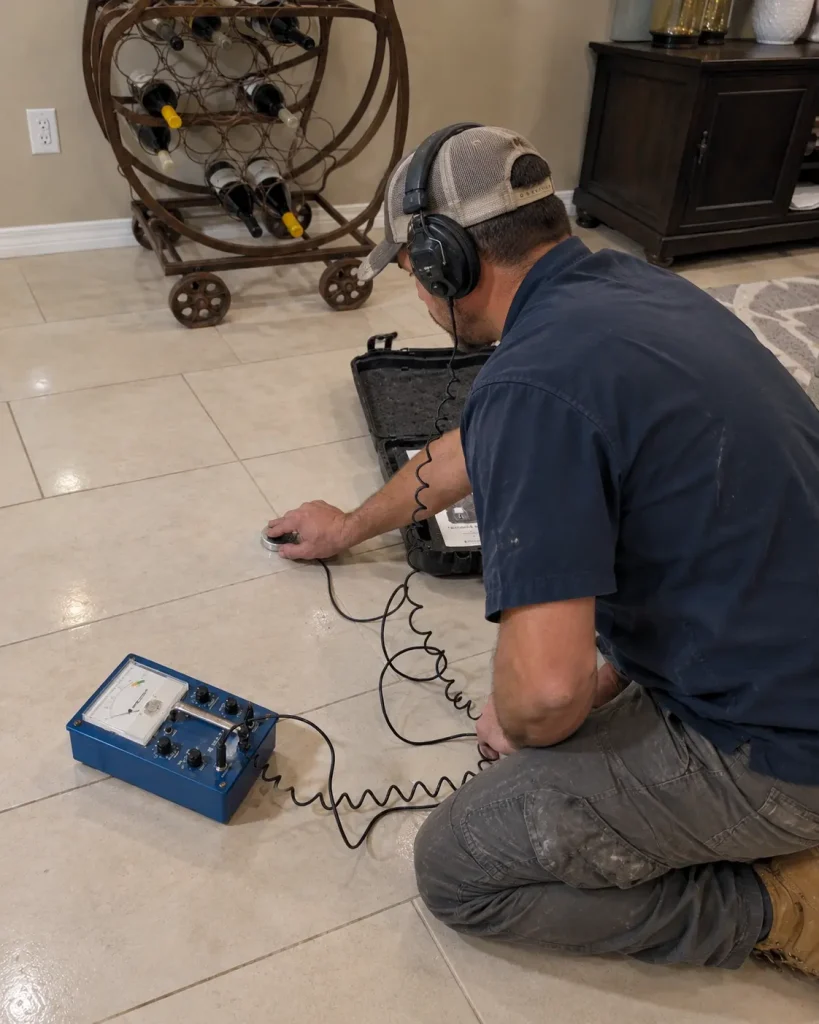
Tunneling requires knowing where the damaged pipe is before planning the access route, entry point, and tunnel direction.
If the leak has not yet been located, detection comes first.
If you are still matching symptoms, compare them against the warning signs of a slab leak first.
If you have not confirmed the source of your under-slab water loss, our slab leak detection service can help identify the exact pipe location before repair or tunneling decisions are made.
Comparing Slab Leak Repair Options
Tunneling is one method of accessing a pipe for repair. Depending on the pipe, property, and problem, another approach may be more suitable. For a full overview of slab leak repair approaches, visit our Slab Leak Repair in Perris page.
Tunneling (this page)
Creates physical access to the pipe from below the foundation, potentially reducing interior floor disruption in eligible situations.
Direct slab access
Opening the concrete and flooring from above at the leak location. May be the simplest approach when the pipe is isolated and accessible.
Pipe rerouting
Bypasses the damaged pipe entirely by running new pipe above the slab through walls or ceiling. No excavation of the original pipe run.
Trenchless / less-invasive repair
Methods such as pipe lining that may fix a pipe without direct physical access to the damage. See our Trenchless Slab Leak Repair page.
Which access method fits? A side by side look
| Factor | Tunneling | Direct slab access | Pipe rerouting | Trenchless repair |
|---|---|---|---|---|
| How the pipe is reached | Through a tunnel in the soil below or beside the foundation | Through flooring and concrete from inside, above the leak | Not reached at all; a new line bypasses it overhead | From inside the pipe, usually by lining, with no excavation to the damage |
| Interior flooring | May stay intact in suitable cases | Floor and slab above the leak typically opened | Stays intact; walls or ceiling opened for the new run | Usually untouched |
| Best fit | Pipe accessible from below, interior floor worth preserving | Short isolated leak easily reached from above | Pipe cannot be reached practically, or repeat leaks argue for a new route | Pipe condition allows lining and access points exist |
| Main limit | Not practical for every property, soil, or leak | Very disruptive when flooring removal would be extensive | Old pipe stays in place, abandoned | Not every damaged pipe can be lined |
Our Slab Leak Tunneling Process
Every tunneling job follows the same core sequence, though the specifics depend on the property, the leak location, and the repair required.
- 1
Review the leak location
We use existing detection findings to confirm exactly where the damaged pipe is beneath the slab. If detection has not yet been completed, that step comes first before any tunneling plan is made.
- 2
Assess foundation layout and site conditions
We review the foundation type, perimeter access, soil conditions, pipe depth, and available working space to determine whether tunneling is practical and where the access point can be opened.
- 3
Plan the tunnel route
We identify the most direct and workable path from the entry point to the damaged pipe. The route, depth, and any constraints are discussed with the homeowner before work begins.
- 4
Create the under-slab access
Soil is removed carefully to open a passage beneath the foundation toward the repair area. The tunnel is sized to allow the repair work to be completed properly.
- 5
Complete the pipe repair
The damaged pipe section is repaired or replaced through the tunnel access. The repair type depends on the pipe condition, material, and the extent of the damage.
- 6
Test and restore the access area
The repaired pipe is tested to confirm the leak has stopped. The tunnel is then backfilled and the entry area is restored appropriately for the property.
How Much Does Slab Leak Tunneling Cost in Perris?
Tunneling in Perris typically falls in the range of $4,000 to $8,000, as published on our slab leak repair cost guide.
The final figure depends on the job itself, and costs are explained before work begins. Detection is a separate step that comes first when the leak location is not yet confirmed.
Tunnel length and depth
How far the damaged pipe sits from a practical entry point, and how deep it runs, shapes how much soil work the job needs.
Soil conditions
Clay-heavy Perris soil, seasonal movement, and site access affect how the tunnel is opened and supported.
Pipe material and damage
The pipe type, its condition, and the extent of the damage decide whether a section is repaired or replaced through the tunnel.
Access and restoration
Perimeter access, landscaping, exterior clearance, and restoring the entry area after backfill all factor into the total.
Why no per-foot price? Tunneling length, depth, soil, and repair extent differ on every property, so a single per-foot figure would mislead. The range above reflects the whole job, and your figure is explained before work begins.
How Long Does Tunneling Take, and What Gets Disrupted?
No fixed timeline fits every tunneling job. What sets the timeline:
- Tunnel length
- Soil conditions
- Repair extent
Your timeline is confirmed after the foundation layout and site assessment, before work begins. You hear it for your property rather than a general promise.
Disruption follows the same pattern. What to expect:
- Work area at the entry point, usually at the perimeter, not across your interior floors
- Interior flooring stays intact in suitable cases
- Exterior entry area, landscaping, and clearance around it are the parts affected
- Water is off while the damaged section is repaired and tested
- Tunnel is backfilled and the entry area restored after testing
Is Tunneling Under a Foundation Safe?
This is the question homeowners ask most once they picture a tunnel under their home, and it deserves a straight answer.
Safety in tunneling comes from assessment before digging, not from digging itself.
What assessment covers
- Foundation type and layout
- Perimeter access and available working space
- Soil conditions
- Pipe depth
- Footing position relative to the planned route
The route is planned from that assessment. If the assessment shows tunneling is not a safe or practical fit for a property, another access method is recommended instead.
Two parts that matter most
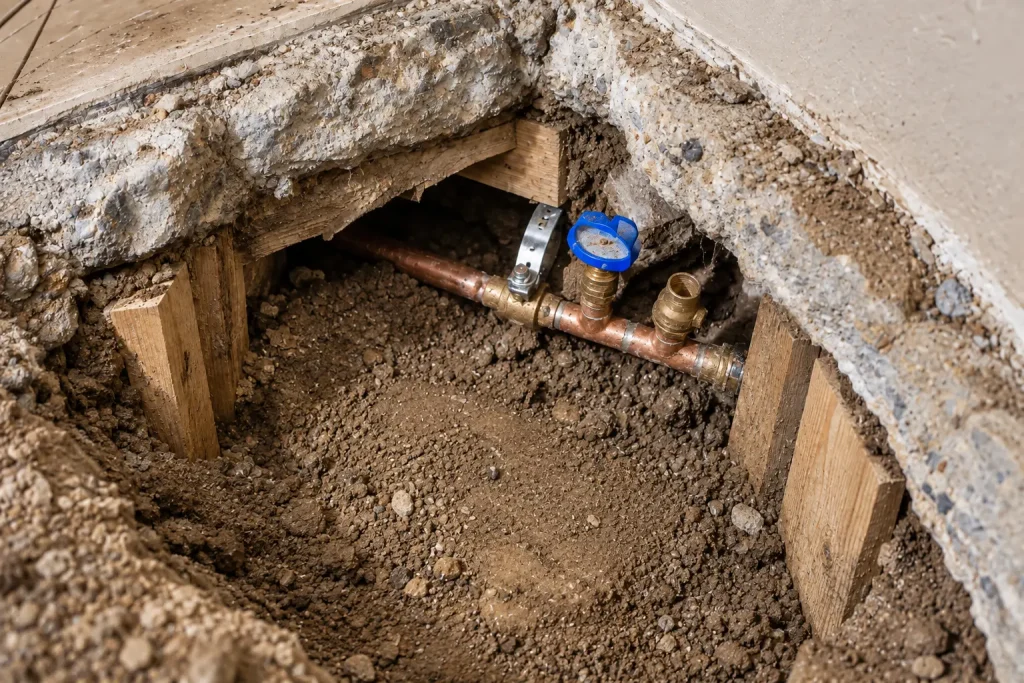
- The access pit. Soil is removed carefully, and shoring boards support the pit walls, as shown in the access photo above.
- The footing. A route that cannot pass a footing safely is not used.
After the repair is tested, the tunnel is backfilled and the entry area is restored, so no open void is left behind.
What tunneling cannot promise is a guarantee for every property. Soil, layout, and pipe location differ from home to home, which is why the assessment step exists. A plan that fits one property may not fit the next, and saying so before work begins is part of an honest assessment.
Permits and Inspection
- Whether a permit or inspection applies depends on the job scope and city requirements.
- Confirmed during the foundation layout and site assessment, before work begins.
- The homeowner verifies requirements with the city. No permit or inspection outcome is promised before that assessmen
Slab Leak Tunneling vs Direct Slab Access
Both approaches can be the right answer depending on the leak, the pipe, and the property. This comparison reflects general differences rather than a universal rule.
| Factor | Tunneling | Direct Slab Access |
|---|---|---|
| Primary entry | Exterior soil beneath or beside foundation | Through flooring and concrete from inside |
| Interior flooring | May reduce interior floor disturbance in suitable cases | Floor and slab above leak location typically opened |
| Exterior disturbance | Soil work, landscaping area at entry point | Minimal exterior work typically needed |
| Best fit | Pipe accessible from below, interior floor worth preserving | Short isolated leak easily reached from above |
| Soil requirements | Conditions must support safe excavation | No soil excavation required |
| Suitability | Not practical for every property or leak | Not ideal when flooring removal would be very disruptive |
Slab Leak Tunneling vs Pipe Rerouting
Tunneling
Provides physical access to the existing damaged pipe from beneath the foundation. The original pipe is repaired or replaced in its current location.
The plumbing route does not change. Tunneling makes sense when the pipe can be accessed from below and a direct repair at the damage point is the right approach.
Pipe Rerouting
Bypasses the damaged pipe entirely by running a new line through a different route, typically above the slab through walls or ceiling.
The existing under-slab pipe is abandoned. Rerouting does not require access to the damaged pipe location. See our dedicated Pipe Rerouting in Perris page.
Slab Leak Tunneling for Perris Homes
Perris sits on alluvial valley soil that contains a mix of clay, sand, and silt. This is the Perris Block geology at work.
Perris grew around its depot, with rail service from April 1886, and the Southern Hotel dates to 1886 at 445 S. D St. The city was incorporated in 1911. From Downtown’s older homes to newer communities such as May Ranch and Green Valley Ranch, and from North Perris and South Perris to Rancho El Dorado along Perris Boulevard and the I-215 corridor, local homes share the same slab and soil pattern.
- Clay-heavy soil expands when wet and contracts when dry, stressing pipes over time, and where movement is stronger, pipe joints and longer straight runs fail first.
- Many 1980s and 1990s homes in 92570 and 92571 have copper lines. Reactive soil and hard Eastern Municipal Water District (EMWD) water, around 212 PPM, corrode pipes under soil pressure and joint stress until they fail. Findings are documented for EMWD leak adjustment paperwork.
- Lot size, perimeter access, and clearance decide whether tunneling fits a specific home.
Ask About Tunneling for Your Perris Home
We assess your foundation, soil, and pipe location and explain whether tunneling is a practical option for your specific repair.
Why Choose Slab Leak Pros for Tunneling in Perris?
- Honest repair assessment. We compare tunneling against other access options and recommend what fits the pipe, property, and repair. If a simpler approach is more appropriate, we say so.
- Clear communication. We explain whether tunneling applies to your situation, what access points would be used, and what the repair would involve, before any work begins.
- Perris focus. Slab leaks in Perris are what we focus on. We understand how local soil conditions, foundation types, and aging pipe materials affect repair access decisions.
- Options and prices before decisions. Tunneling cost range and cost factors are explained before work begins, so the decision is made with numbers in hand, not after.
- A written report. Detection findings and the access plan are documented, so you have a written record for your repair decision and for leak adjustment paperwork.
Insurance and EMWD: What to Know Before Tunneling
Insurance
Homeowners insurance treats access work and pipe repair differently in many policies. Whether tunneling access, the pipe repair, or both are covered depends on your policy, not on the repair method. Your policy and adjuster decide what is covered, so check both before work begins.
For tunneling, the access question matters as much as the pipe question. A policy may treat digging access and pipe repair differently, and sudden damage is not treated the same as long-term wear from aging copper and soil movement in every policy. Deductibles apply per your policy, which is why the written findings for your tunnel route and repair matter when you talk to your adjuster.Documentation and EMWD
If you plan to claim, documentation matters. Detection findings and the access plan are documented in a written record, which supports a claim and is also used for Eastern Municipal Water District leak adjustment paperwork. Ask your insurer what documentation the adjuster needs, and keep the written record with your claim papers.
Slab Leak Tunneling: Common Questions
How much does it cost to tunnel under a slab?
Tunneling in Perris typically falls in the range of $4,000 to $8,000. The final figure depends on tunnel length and depth, soil conditions, pipe material and damage, and access and restoration. Detection is a separate step that comes first when the leak location is not yet confirmed. See our cost guide for the full picture.
Can tunneling under a slab foundation weaken it?
Tunneling is planned around the foundation, not through it blindly. Foundation type, layout, soil conditions, and pipe depth are assessed before any route is planned. If that assessment shows tunneling is not a safe or practical fit for a property, another access method is recommended instead.
Is tunneling safe? What about tunnel collapse?
Soil is removed carefully, and shoring boards support the access pit walls. The tunnel is sized only as large as the repair requires, and it is backfilled after the repaired pipe is tested. If site conditions differ from the assessment, the plan changes rather than proceeding as first drawn.
What happens to the tunnel after the repair? Is it backfilled?
Yes. After the repaired pipe is tested to confirm the leak has stopped, the tunnel is backfilled in layers and the soil is compacted, so no open void is left behind. The entry area is then restored appropriately for the property, and the finished surface is checked before the crew leaves.
Can you tunnel under a foundation footing?
It depends on where the footing sits in relation to the planned route. Footing location and depth are part of the layout assessment done before route planning. If a footing blocks a safe route, that route is not used and another access method is recommended.
Tunneling vs rerouting vs jackhammering: which fits when?
Tunneling repairs the existing pipe in place from below and suits pipes that can be reached from below with floors worth preserving. Rerouting abandons the old pipe and runs a new line overhead, which suits pipes that cannot be reached practically. Jackhammering opens the floor and slab above the leak and suits short, isolated leaks easily reached from above.
How can a plumber repair a slab leak without breaking through the foundation?
By reaching the pipe from below instead of from above. A tunnel is dug through the soil beneath or beside the foundation from an exterior entry point, the pipe is repaired through that tunnel, and interior flooring may stay intact in suitable cases. Not every property qualifies, and assessment decides.
How deep are plumbing pipes under a slab house?
There is no single depth that applies to every home. Pipe depth is reviewed during the foundation layout and site assessment, along with foundation type, perimeter access, and soil conditions. The route and depth for your property are confirmed in that assessment, before work begins.
How long does tunneling take?
No fixed timeline fits every tunneling job. Tunnel length, soil conditions, and the extent of the repair all affect duration. Your timeline is confirmed after the foundation layout and site assessment, before work begins, rather than as a general promise.
Does homeowners insurance cover tunneling, or only the pipe?
Policies differ, and access work and pipe repair are not always treated the same way. Detection findings and the access plan are documented in a written record that supports a claim, and the same documentation is used for Eastern Municipal Water District leak adjustment paperwork. Your policy and adjuster decide what is covered, so check both before work begins.
Need Slab Leak Tunneling in Perris?
If you have a confirmed or suspected under-slab pipe problem and want to understand whether tunneling is a viable access option for your property, give us a call. We will assess the leak location, foundation, and soil conditions and explain which repair access method makes sense for your situation.